


"The chaotic atmosphere that may result from emergent AI technology in the next five years may fuel large-scale protests that devolve into civil unrest and anti-tech violent extremist activity, especially in large urban areas such as New York City,"
WIRED, May 26, 2026
WIRED obtained over “1,000 pages of unpublished reports from the Department of Homeland Security, FBI, and fusion centers” discussing the potential for “anti-technology extremists”. The Trump administration has an aggressively pro-AI, pro-fossil-fuel, and pro-deregulation agenda (“American energy dominance”, the Stargate Initiative), but it also has a problem: opposition to AI and, in particular, data centers, is a cross-partisan issue.
A substantial proportion of Republican voters somewhat or strongly oppose data centers in their local area:
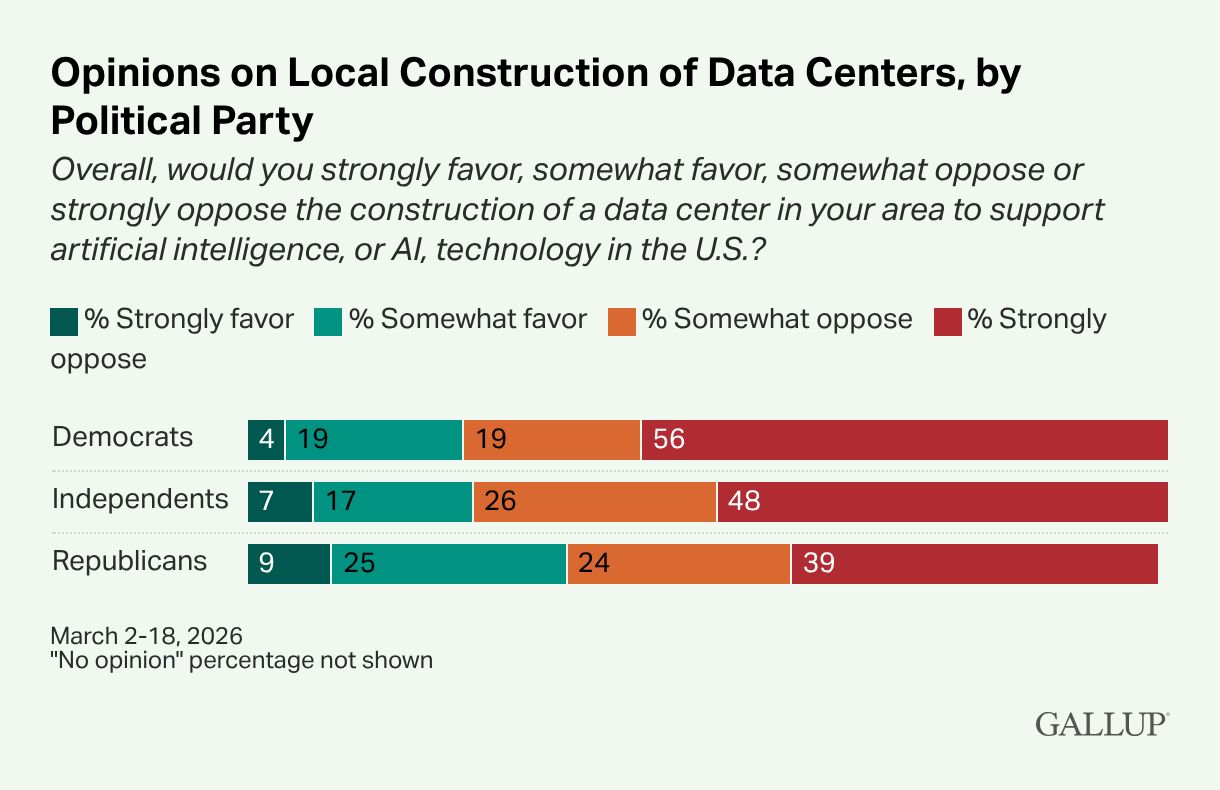
So… is categorizing local opposition to data centers as a left-wing security threat an attempt to enforce ideological discipline on a populist conservative base that is increasingly finding common ground with environmentalists on this issue?
Let’s back up and look at what’s underlying this first.
The activities that fall under this ‘anti-tech extremism’ threat category are broad. There’s potential for legal and constitutionally protected behaviors to be flagged as indicators of extremism: observing and taking photographs of data centers, ‘testing/probing of security’ (citizens asking security guards questions?), and “expressed/implied threat” (heated public comments at hearings?).
“But perhaps the clearest-cut example of how nonviolent critiques of technology can be swept up along with threats is found in an open-source report circulated by SITE Intelligence in April 2025. The report flags a video from the progressive nonprofit More Perfect Union on the destructive effects of a data center to nearby residents in Georgia. Nothing in the video advocated for violence against property or people. But thanks to fusion center targeting, the advocacy group is now circulating among US intelligence and law enforcement across the country as a potential threat vector.”
WIRED, May 26, 2026
This domestic surveillance appears to be part of the direct enforcement of executive directives that criminalize political opposition: NSPM-7 (Countering Domestic Terrorism and Organized Political Violence) instructs Joint Terrorism Task Forces, the IRS, and the Treasury Department to target “criminal and terroristic conspiracies” operating under the “umbrella of self-described ‘anti-fascism’”:
“anti-Americanism, anti-capitalism, and anti-Christianity; support for the overthrow of the United States Government; extremism on migration, race, and gender; and hostility towards those who hold traditional American views on family, religion, and morality.”—NSPM-7
Tying anti-capitalism and “extremism on migration, race, and gender” directly to domestic terrorism lets federal agencies investigate and disrupt progressive networks. Bringing in the AI and data center narrative in this context lets the state brand critique of the associated resource extraction as anti-capitalism and anti-Americanism… an assault on “American energy dominance.”
The actual powers these directives give investigative agencies isn’t the most prominent risk, though. The main risk is in the narrative itself and what using words like “extremism” does to shut down opposition from people who weren’t even going to attend a protest.
Let’s come back to that 63% of Republicans who oppose data centers
The backlash against data centers is justified (regardless of who is doing the backlashing). And it’s widespread. I first started looking into this issue around a month ago after it came up in a live chat I was part of, and now my algorithm is constantly feeding me data center content. I don’t think this is algorithmic inflation of the issue, though. Data centers consume millions of gallons of water per day. They suck up massive amounts of electricity and strain local grids, forcing utilities to keep “dirty coal plants” online and pass the multi-billion-dollar costs of infrastructure upgrades directly onto residents, whose energy bills are increasing. They may create jobs, but those jobs might be primarily temporary.
These issues affect everyone, and as I mentioned above, this is a cross-partisan issue and one of the biggest challenges the Trump administration has in the data center effort is the common ground between Republicans and Democrats on the negative effects it has. Left-wing activists for climate and water protection who are against corporate monopolize and advocate for utility consumers have a common ground with right-wing populists who are for property and land use rights, local autonomy, grid safety… and anti ‘Big-Tech’. So conservative farmers, property-rights advocates, and local homeowners are organizing with progressive climate activists to block projects, and local Republican candidates in some states are going against the Trump administration’s “Build, Baby, Build” AI directives to align with their angry constituents.
If conservative farmers, for example, and progressive climate activists come together to fight the same enemy… the left–right divide on the issue isn’t there.
So what if the Trump administration’s solution to that is to re-polarize the issue?
Classifying anti-AI/data-center activism as a left-wing extremist threat reads as the Trump administration running a counter-insurgency tactic on its own base. A Republican voter in a rural area facing rising electric bills and water depletion will see opposing the data center as a neutral, conservative position. But if the White House starts repeatedly framing that position as left-wing, extremist, anarchist, anti-American, eco-extremist (I could go on) and against American progress, that introduces a psychological barrier for the voter that can’t easily be crossed. Opposing the data center is aligning with the ‘enemy’. Supporting it is standing with Trump and America.
Calling opposition “anti-tech extremism”, in my opinion, looks suspiciously like an attempt to align the base with the narrative the administration wants, forcing them to accept the environmental, and financial costs by turning it into part of the ideological ‘culture war’. Not an attempt to counter actual terrorists.
This framing ‘sticks’ even when there’s clear negatives because of how we’re wired to prioritize social survival over factual accuracy (identity-protective cognition); being socially exiled from ‘our people’ feels the same as a physical threat, so a ‘disagreement over local zoning laws’ feels safe enough to be analytical about, but adding ‘extremist’ and ‘national security threat’ to the narrative turns that same disagreement into an existential threat. There’s a huge psychological difference between saying someone is “protesting a data center” (describing an action) and labeling them “an extremist” (defining an identity). Using identity-defining labels implies an inherent personality characteristic, so we stop seeing, for example, a concerned local farmer, and start seeing ‘the enemy’.
There’s also cognitive dissonance involved in confronting the reality that the political leaders we support are enacting policies that actively harm our communities, and we want to resolve the conflict. So when the administration offers a convenient scapegoat like left-wing eco-extremists, we accept the label because it protects the existing belief system. It’s easier for a Trump supporter to believe an outside agitator is causing issues than admit it’s their own leader selling out resources, and then they may support the administration’s narrative because they don’t want to be classified as one of those outside agitators, even if they actually oppose that data center.
From there, once we accept the initial framing that opposition to AI progress and data centers is anti-American, our minds begin to filter all subsequent information through that lens, so we might see someone protesting maintain property rights as a suspicious act of subversion, even if we’ve always supported property rights in the past. The narrative becomes how we interpret reality.
So this type of rhetoric (take an issue, frame it as a national security threat, deploy state surveillance, enforce compliance by dividing potential cross-partisan coalitions before they can act) actually changes how we perceive the truth. It forces people into protecting their ideological identity and traps them in a thought process that makes it seem justifiable to support policies that directly harm them. And it is not a new approach, as anyone familiar with US history will be aware.
What’s next?
Anti-data center movements are essentially saying that local communities should have the right to decide how their land, water, and electricity are used, and that we can’t sacrifice these things to power AI. That is not an extremist or unreasonable perspective, and it also isn’t political in nature. Bringing in this “anti-tech extremism” narrative is an attempt to make it so and reduce the backlash by essentially redirecting it.
This is what’s happening. Recognize it when you see it and decide what you're going to do with that knowledge. My motivation for sharing this is awareness. Be aware that the people you support who want and need your support to further their agenda can and will communicate issues in a way that forces you into supporting their stance when you otherwise wouldn’t. One way that I find particularly effective for myself when checking biases is to ask myself if I would support/believe something I’m being told by a side I’m already aligned with if the same thing was coming from the opposing side. If the answer is no, I need to look more closely at why I’m supporting it and believing it now.