


On January 27, 2026, Kanye West (also known as Ye) took out a full-page ad in The Wall Street Journal to issue an apology letter addressing the impact of his recent antisemitic remarks and his struggles with mental illness:
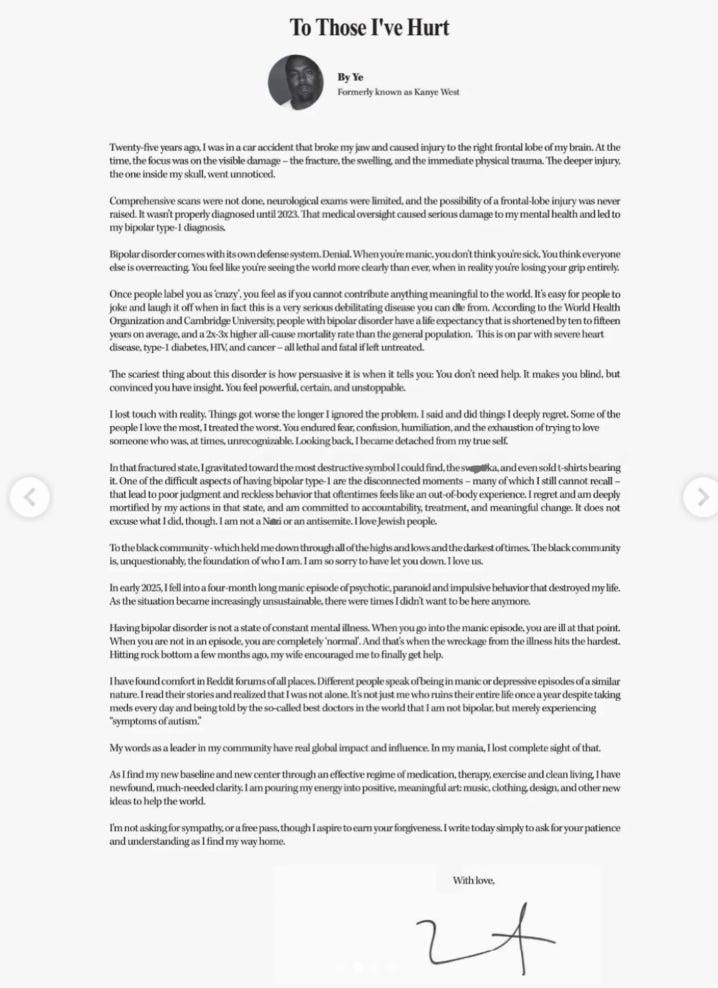
I personally think this is quite a good statement. There’s a lot of accountability in there for the impact of his experiences with mental illness. What he does next will show whether it’s genuine sentiment or not.
Commenters’ sentiments on Reddit are mixed, with many appreciating his demonstration of accountability and description of mental illness, and others questioning whether it is a PR move related to his new album release.
A few stood out to me:


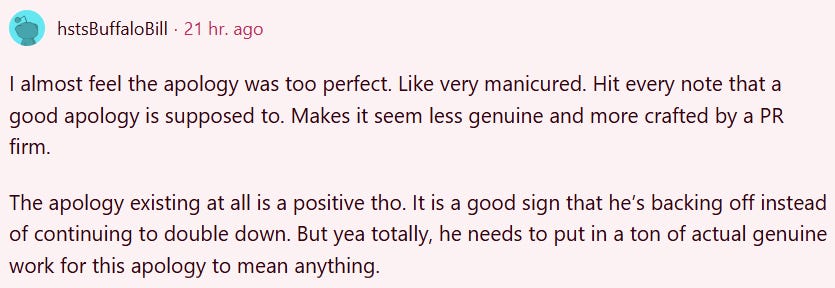
These comments center on whether West actually wrote the statement it himself, and this skepticism highlights a common (yet counterproductive) tendency in how we evaluate public apologies. The immediate suspicion that a PR advisor crafted the message often leads to dismissals of its authenticity; however, this focus on authorship is a distraction.
He probably didn’t write that statement as it appears in print. But who put those words together matters less than the sentiment behind them. It’s the sincerity of the sentiment and the commitment to future action that require attention when statements like this come out, not who physically arranged the words on a page.
PR advisor involvement is justifiable and often necessary for effective communication.
How PR advisors write statements
(Well, I should say, how this PR advisor writes statements, because I can only definitively speak for myself… but my approach is common among ethical practitioners)
Here’s how it usually works when I have a client who needs a statement written. While I do look at the whole situation and assess what the absolute best response (and associated sentiment from the person the apology is coming from) would be, I don’t write the statement from that analysis, give it to the client, and say, “This is how you feel”. No. That would be inauthentic. We don’t impose the most effective responses on our clients.
The best sentiment and approach is often not reality and doesn’t reflect how they actually see the situation or feel about it. It’s not what they want to say or can reliably stand behind. Remember that a statement is just words. It’s an explanation and a promise, and future words and actions must align with it for it to be effective. If a person doesn’t believe what they’re saying in a statement they put out, their future actions won’t match the sentiment of the statement and that will undo everything the apology was intended to do. So there’s no point in writing it.
This is one reason why sometimes, when an apology comes out, it’s criticized because it could have been better or didn’t go far enough. The public often wants the ideal apology… the one that would perfectly align with objective reality. What they are actually getting is the most accountable version of the truth that the individual or organization is prepared to offer at that moment. My role is to guide them toward that truth, not to fabricate it.
So what do I do? The first step doesn’t involve writing at all. It involves listening.
I determine my clients’ actual thoughts, feelings, and experiences regarding the situation and how they perceive it. I present the ‘best case’ to them, but ask them where it aligns, where it doesn’t, what is and isn’t true for them in it. I collect as much information as humanly possible through asking questions (or asking for written commentary, if they prefer that to conversation), and then I write a statement that captures my client’s true sentiment from what they’ve told me.
Yes, I advise on specific approaches and explain how each is likely to be received by the client’s stakeholders or play out in the media. I discuss intentions and goals and outcomes, what each part of the statement is intended to do, and how it will be received. I coach them toward demonstrating genuine accountability, accepting responsibility, and determining ways to move forward and rebuild trust. I look at the factors that contribute to whatever it is they’re apologizing for and determine how these need to be explained.
But I don’t put words in their mouth or write a statement that lies.
Sometimes, the statement we end up with isn’t at all what I’d write if I were writing it for myself, but these aren’t for me. If I think it’s best that someone puts out a statement accepting responsibility for something they have consistently refused to accept responsibility for, knowing that they will go on a YouTube Live and blame 10 other people for it in two weeks’ time… having them put out that statement would be a bad move because they’re not ready to issue it. It’s not true (yet… people do change their minds on accountability).
I don’t make up facts or write things that contradict my clients’ perspectives and feelings. I do help shape those things. But the final statement is a reflection of their sentiment, their words, reorganized for public consumption.
Why people have PR advisors write statements
Being able to feel remorse and a desire to make amends is a completely different skill from being able to write a cohesive and compelling public statement. I once had a client who sent me over a dozen long, rambling emails detailing their perspective on a situation (awesome, by the way - I want your honest info-dump, not a curated selection of points… it helps make the final product authentic). The key points for a powerful apology were all there, but they were buried in a torrent of emotion that would have undermined the message if released in its raw form.
My client could not have written the final statement I drafted, but every word of it was rooted in their own feelings and expressions.
A person should not have to be a master of public communication to be able to apologize effectively. That is why PR advisors exist. To help people express their truth in a way that can be heard and understood.
There is a clear distinction between getting a PR advisor to ‘spin’ a situation in a way that distorts the truth and getting help to express the truth effectively. The former is not ethical; the latter is both acceptable and often essential for genuine reconciliation.
Why we should think twice before criticizing someone for having a PR help them write their statement
There is a peculiar hypocrisy in how the public treats apologies from prominent figures. When a public figure issues a statement that is unpolished, emotional, or poorly worded, they are often criticized for their lack of professionalism and failure to grasp the gravity of the situation. The message is lost in the clumsy delivery, and the apology is deemed insufficient. They are told they should have sought professional help.
Yet… when a statement is articulate and demonstrates a clear understanding of what needs to be said, it can be dismissed it as a ‘PR move.’ The involvement of a PR advisor is seen as a sign of inauthenticity, and the person is criticized for not speaking from the heart. They are, in effect, punished for taking the very advice those in the first scenario were given.
This double-bind where there’s is no right way to apologize shifts the focus from the content and sincerity of the apology to a cynical guessing game about its origins.
This is counterproductive.
It leads to perpetual outrage where no attempt at reconciliation can ever be good enough and suggests that we are more interested in finding reasons to remain angry than in allowing for the possibility of genuine remorse and change.
Instead of dissecting an apology for traces of PR work, it’s much more productive to focus on the substance of the message and, more importantly, the actions that follow.
A well-written statement (regardless of who drafted it) is a promise.
The true test of its authenticity lies in whether that promise is kept.