


On Friday, July 24, a woman went for drinks at her local pub with her partner and kids. She was informed at 9:30 PM that the kids would need to be out of the pub in 30 minutes due to licensing restrictions on the times children are allowed in. Per pub management and witness accounts, the woman refused to leave despite numerous polite requests and became verbally aggressive toward a staff member. This confrontation was witnessed by multiple pub patrons.
How do I know this?
At around 1 AM on Saturday, July 25, the pub’s management posted a screenshot of a CCTV image of the woman on the pub’s Facebook page, accompanied by a public post calling her out:
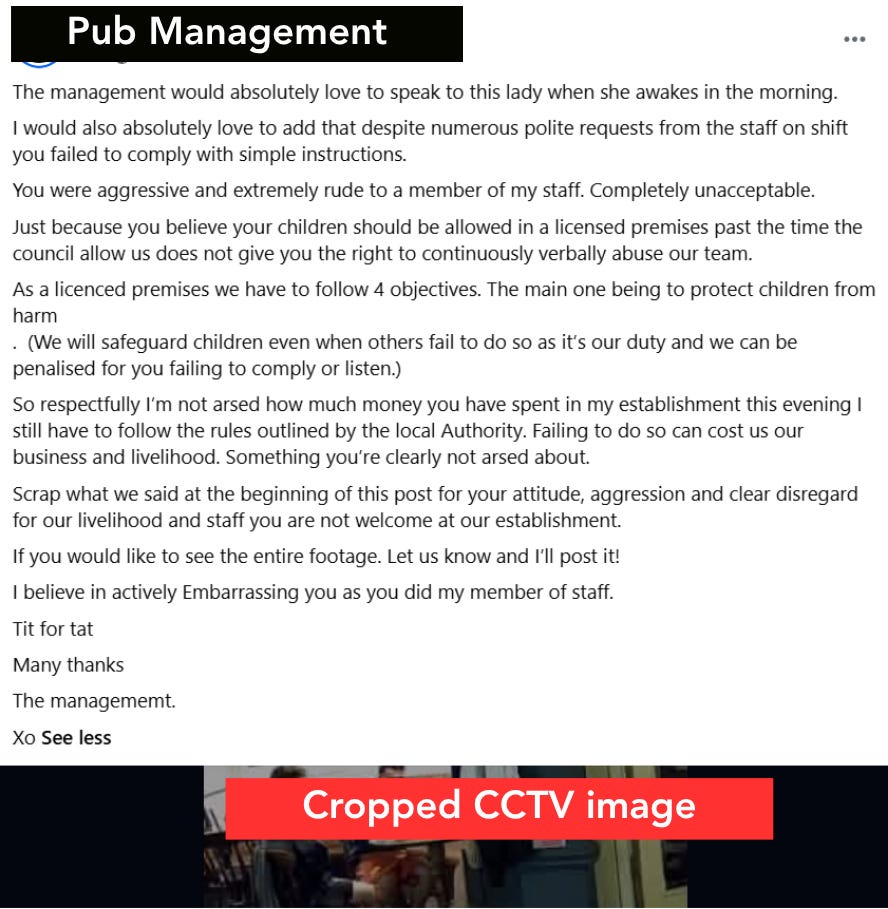
This appeared on my feed and caught my attention because of the number of interactions in the 11 hours since it had been posted:
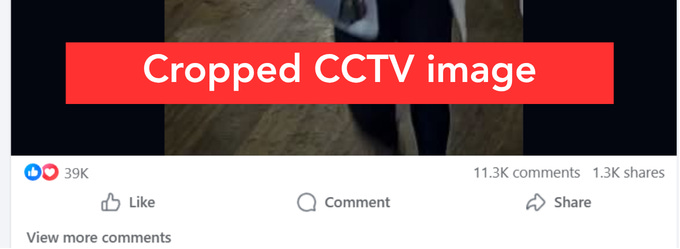
When a post on a local pub’s Facebook page gets ~1,000 comments an hour for 11 hours… that’s an “Oh, shit!” moment.
What’s In The Comments?
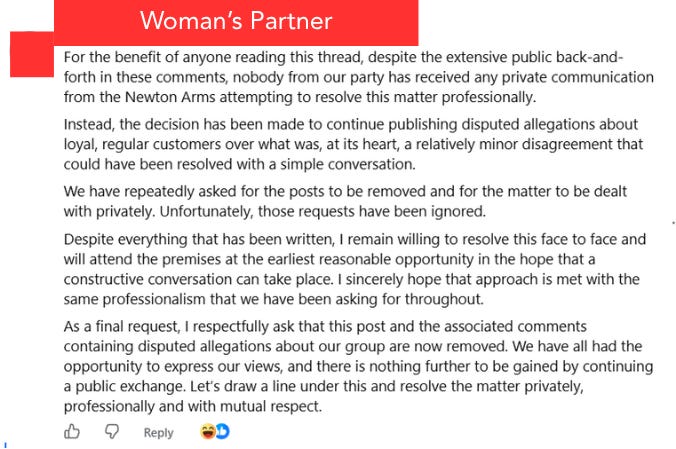
The woman’s partner has responded extensively in the comments (one example below). He hasn’t (as far as I’ve seen—I didn’t read all 11K+ comments, though I did spend quite a long time going through most of them in the “Most Relevant” category) directly denied that the altercation took place. His comments focus on the ethics of the pub’s callout, accusing the pub of hypocrisy, indicating that they can’t claim to protect children (via licensing laws) and also threaten to publish CCTV footage of children on the socials, and requesting the post be taken down to resolve the matter “privately, professionally and with mutual respect”. He also indicates that he’s willing to meet the pub manager face-to-face to discuss the issue.
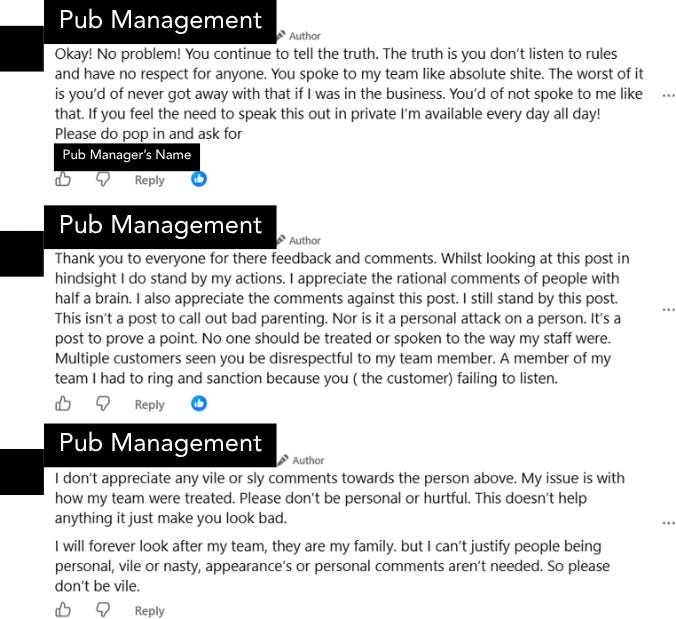
The pub manager, at the time of writing, hasn’t backed down, but has done a little distancing by saying that it’s not supposed to be a callout post but making ‘a point’, asking people not to post ‘vile’ or ‘nasty’ comments about the woman:
The Sentiment
The sentiment in the comments from those who weren’t involved is (at the time of writing) overwhelmingly leaning in one direction: support of the pub (~85% of the comments I screened). Most commenters support the management, praising the manager for protecting his staff and bringing consequences for abusive behavior. The sentiment toward the woman in many of these comments is extremely negative, with numerous judgments of her parenting. Many are also asking for the full CCTV footage to be posted.

A significant (for a local Facebook post) number of the comments identify the commenter as being from far outside of the local area. This happened in England, and one commenter mentioned that it had reached her feed in New Zealand. The sentiment in these comments was more neutral, with commenters more engaged by the public drama of it all than being invested in either side. Many comments referenced things like “getting popcorn” or enjoying the “Saturday morning read”.

A smaller group criticized the pub’s actions, indicating that they don’t support people abusing staff, but felt that publicly shaming a customer by posting CCTV images and threatening to release full footage is unprofessional and “tit-for-tat”, with some highlighting a potential breach of the General Data Protection Regulation (GDPR).

The Common Themes
The most common theme in the comments is solidarity with hospitality workers, with current and former bar staff and the general public sharing frustration with the ‘customer’s always right’ mentality and calling the pub manager a “hero” for prioritizing his staff over a customer’s ego or money. Many commenters shared their belief that public shaming is a necessary deterrent because abusive customers rarely face repercussions.


Another sub-theme concerns children in pubs at night, with commenters judging the woman for her aggressive behavior and for being out drinking in a pub with her kids past 9:30 PM.

Regarding the woman’s partner’s responses, many commenters called these out for their formal structure and accused him of using ChatGPT to write them, which became somewhat of a meme in the comments. Commenters indicated feeling that the partner’s overly sanitized language was being used to deflect from the reality of the situation.

And, as expected with viral posts like this, another sub-theme was the entertainment aspect of it all. The algorithm pushed it to a global audience, so people joined in for the drama. This resulted in several commenters warning about the ethics of publicly shaming someone on the socials due to the digital mob it brought in, although many supported the pub management’s approach.

The Analysis
The pub incident is an ordinary dispute. The reason I’m using it for this post is how well it shows how decision-making can snowball into a viral post with potential real-world consequences, and how this can happen to someone who may not even have a social media presence. From a crisis strategy perspective, this incident involves two subjects navigating substantial reputational risk (the woman and the pub) and the broader topic of online public shaming.
Here’s what you can learn from it.
If YOU Are Publicly Called Out
When we become the target of a viral callout, we tend to either panic and withdraw, respond defensively and aggressively, or come out with long, desperate attempts to control the narrative with too much information or overly legalistic phrasing. The woman’s partner’s responses in this case were articulate and made several valid points (e.g., that threatening to post CCTV with children in it is hypocritical); however, he responded repeatedly and at length in the comments section of the post as it was going viral, providing a steady stream of new material for the commenters to engage with. This is an example of how responses can escalate rather than de-escalate a situation, as his engagement likely contributed substantially to the post continuing to go viral. That was sustained by his participation in the thread. What we want to avoid in situations like this is inadvertently adding fuel to the fire and making a viral moment even more viral.
Instead, when you become aware that you (or someone you feel compelled to defend, as in this case) are the subject of a viral post that calls you out, you need to take a step back and properly assess the situation, taking several steps to help avoid escalating things:
Private your socials. Before you do anything, lock down your socials so that when people find those (and they likely will), they can’t ‘mine’ your personal photos, find your employer, identify your connections etc. and use these to escalate.
Keep your first communication private. Instead of responding on the post that’s calling you out itself, reach out to the person or entity that posted it in private via, for example, direct message or email. Responding directly, such as in this case, can become further ‘entertainment’ for the people who are watching for the drama.
Consider the truth. You may want to construct a narrative where your behavior or that of the person you’re defending was reasonable and the other side’s was disproportionate, but be honest with yourself (it will help save you from making everything worse, no matter how uncomfortable it is now): If you saw a stranger doing what you did, would you think they behaved well? If ‘no’… your response needs to be built on accountability, not damage control. In this case, for example, even if the pub’s response was disproportionate, the woman’s behavior wasn’t acceptable. Two things can be true at once.
Decide whether to stay silent or respond. The most effective strategy is often silence when the situation is local virality within something like a Facebook group or page, especially when you haven’t been publicly named (like in this case; the CCTV showed the woman’s face, but she wasn’t named, and her partner was also not named, but now everyone reading the comments knows his name). Something like a local pub dispute like this tends to fizzle out within 24-72 hours if no fresh content (like your responses in the comments) is added. Without names, your employer isn’t likely to come across it, and your social circle might not see it if you’re not engaging and they’re not connected to the audience of the post. A public response is necessary when your identity has been revealed and, thus, has the potential to cause harm to your relationships and employment, for example, or if the allegations contain material falsehoods you need to correct, or if you have a professional or public profile that in itself makes you visible and likely to be identified.
If you need to make a response: The statement must own your behavior without qualification and it must validate the people who were harmed. It must also demonstrate a commitment to change that you can actually deliver on (one of the most damaging things a person can do in a crisis response is make promises they then immediately break, so don’t ‘over-promise and under-deliver’ here). What your response absolutely must not do is blame-shift back onto the person calling you out for calling you out, even if that is valid criticism. Embedding that criticism in your apology tells the audience that you care more about your reputation than the harm your behavior caused, which is… not an effective strategy to protect said reputation.
If people in your life see the post: You may have to have several difficult conversations as a result of being called out publicly. Consider who is likely to have seen the post. If it’s gone as viral as the one in this example, consider that your employers or colleagues or close family members may have seen it or may later see it. To your employer, acknowledge what happened plainly, confirm that it does not reflect your professional conduct or values, and, if relevant, note any steps you’re taking to address the underlying issue (that might be addressing your alcohol consumption or stress management, for example). Don’t overly focus on the actions of the person who called you out or attempt to relitigate the incident. An employer’s main concern will be whether the situation represents a risk to the business or your ability to do your job, so your response should directly address that concern. You can be more candid with your family and close friends, but still avoid blame-shifting and evasiveness, as people tend to respond more negatively to these approaches than to the initial incident itself (“It’s not what you did, it’s how you responded”, for example… we’ve all heard that at some point). Acknowledge that your behavior was out of character or, if it wasn’t, that it’s a pattern that you need to address (and how you’re planning to address it). That helps preserve trust more than defensiveness does.
If You’re Considering Calling Someone Out
I completely understand the pub manager’s impulse to make that viral post in this case. The post also worked, in a narrow sense, as the pub has clearly demonstrated its stance on protecting its staff and the consequences of abusing them; it has also received an enormous wave of public support and gained thousands of followers. I don’t know how many followers the page had before, but it had ~9,000 when I started writing this 2 hours ago and now has ~11,000.
But.
Working in the short term is not the same thing as making the right decision.
The commenter who called out the GDPR risks was right to do so, as CCTV images that can identify someone are considered personal data in the UK, and the Information Commissioner’s Office clearly states that whatever you do with such data must be necessary and proportionate. Publishing an identifiable image of a customer on the socials with a stated goal of embarrassing them is, though I can’t say so definitively, likely to fail that proportionality test. Regardless of the ethics of posting CCTV footage, making that post exposes you or your business to formal ICO complaints and potential enforcement action, along with civil claims from the people in the video relating to misuse of private information. It’s important to consider the legality and associated business and personal risks of posting callouts before you post them, because you can’t take them back. Even if you delete, there will be screenshots.
Other legal considerations, depending on the specific situation, include defamation and harassment; if any allegations you make may be untrue or materially exaggerated, you could face a defamation claim, and a post that reaches tens of thousands across multiple countries very well might meet the standard for serious harm under the law. If your defense is that the allegations are true, you will need to be willing and able to demonstrate so in court. Harassment laws might be violated in cases where you post something that invites public comment and then continue to engage with (thereby implicitly encouraging) hostile comments about the person you’ve posted. In this specific case, several commenters also noted that it’s illegal to be drunk in a licensed establishment while in charge of a child and that the pub’s management should’ve contacted the police or social services rather than posting online. So be sure of your motivations and what the correct actions are.
Moving onto the ethical aspect, the ethics of publicly calling someone out like this pub did are complex. The pub manager acknowledged this himself in the comments I screenshot above, asking people not to make nasty comments about the woman’s appearance. The thing to remember is that once you’ve posted something like this, you then have absolutely no control over what your audience does with it. The comments section can go way beyond anything you intended when you made the post. You need to be mindful about the fact that you’re starting a process you won’t be able to contain if it goes viral and attracts an audience you’re entirely unfamiliar with.
A Better Approach
Instead of acting on impulse to post that CCTV screenshot and publicly embarrass someone, consider what your longer-term goals are and where your interest is in the situation. In this case, the pub’s interest is protecting its staff from abuse and its license from having customers break licensing laws. The decisions the pub made in its response to the incident made this a viral social post. By that, I mean the decisions that were made before the post.
The chain of events were (from what I can tell from the post and comments) as follows:
Customer refused to leave after licensing hours —> customer verbally abused staff —> customer left without apologizing —> pub posted CCTV screenshot inviting public comment —> customer contacted to apologize —> pub continued engaging on public thread.
The decisions made by the pub prior to the post that resulted in the post being made were continuing to engage with the customer and involving the manager via phone rather than disengaging and calling the police. They then chose not to handle the issue by contacting the individual (and potentially banning them) formally in private. The choice to make a public callout post was a choice against private resolution, which, depending on your situation, can be challenging to defend. The post specifically calling out and picturing the person, rather than making a generic policy statement that highlighted the incident without focusing on the individual, was also a choice against simply reaffirming zero tolerance for abusive behavior toward staff. After the post was made, pub management continued to engage and invite public comment on the viral post rather than accepting a private apology and closing the matter.
These decisions make it hard to defend the later assertion that the intention was to highlight protecting staff against abusive behavior and protect the business in terms of licensing laws. When you specifically target a person in a callout post, you are targeting that person, regardless of whether you’re doing so to highlight another specific issue, and it’s important to consider whether, if you find it necessary to focus on a person to highlight that issue, your true intention may have less to do with the issue itself and more to do with your emotional reaction to the person’s actions. It’s valid to be angry that someone has mistreated a member of your staff, but in this case and any similar situation you might find yourself in, it’s important to take a step back and ask if the initial response you want to make is a response to the issue you care about or your anger that the person’s actions triggered.
I highly suspect that the choice post was entirely driven by the manager’s anger in this situation and that not much thought went into the best way to address the underlying value of protecting staff for two reasons. The first is the use of the phrase ‘tit-for-tat’, which shows that it was motivated by an emotional response to feeling disrespected. Understandable human reaction, but not a good basis for a business decision with potential legal and reputational fallout. The second has nothing to do with the content of the initial post or subsequent comments. It’s the time it was posted: in the middle of the night. If you find yourself wanting to post a callout at 1 AM, please, wait until the morning…. It can wait. Your perspective and considerations may change once your initial anger has subsided. The manager’s follow-up backtracking on the intent behind the post perfectly shows this cycle of initial anger to a later, broader perspective and highlights the problem with acting on that initial anger—the post had been posted, the public judgment had been invited, and the narrative had already been set.
If a public statement is genuinely necessary, which it may have been in this case as several comments mentioned that there were numerous witnesses to the issue, the best statement will focus on your policies and values and not the specific individuals involved. You can reiterate, for example, that you have a zero-tolerance policy for abuse of your staff, describe the incident, and explain that you’ve taken appropriate action without revealing the identity of the individual involved. That gets you the deterrent without the legal exposure and ethical risks.
The Broader Ethical Concerns and Consequences
We all act in problematic ways sometimes. In the past, it’s usually been catastrophic or criminal problematic behavior that’s resulted in a person who isn’t already publicly known ending up in the news or all over social. Now, it can happen to anyone. It could happen to you if a single incident of problematic but not characterizing behavior gets posted online and results in a disproportionate response. People lose their jobs and find it hard to get new ones after incidents like this. It damages personal relationships. And we’re not well equipped to process mass disapproval from tens of thousands of strangers.
People are filming everywhere (and in more discreet ways… Meta glasses, I’m looking at you), and the nature of social media virality has made it somewhat more of the norm to post negative interactions with strangers online (sometimes just for views). So, we need to be aware that our public behavior may no longer be a series of fleeting incidents that witnesses are likely to forget within a few days. Once something is recorded and posted, especially if you end up being named, that’s there forever in a searchable record and may come up repeatedly years later. This is especially the case when media outlets pick up a viral story. You could be named in that, and getting that taken down is unlikely. (You can request it under GDPR if you’re in the UK under the right to be forgotten legislation, but that doesn’t apply if there’s genuine public interest or if there’s a legitimate reason for retaining it; removals are neither quick nor guaranteed). You might also have no opportunity to present your perspective before public opinion is established.
Realistically, what this means is that it’s valuable for all of us to have a good idea of how to communicate if we end up on social media for all the wrong reasons. Even if it never happens to you, it might happen to someone you know. Like in this case, the woman’s partner is the one who responded, and while I believe those responses were likely well-intentioned, the mistakes in them are a good starting point for talking about what not to do.
Although those responses were formally structured and made some valid points, they were almost entirely focused on pub management’s response and not the woman’s behavior. Note that there was also no express denial or acknowledgment of the behavior itself (he used minimizing language, referring to it as a “relatively minor disagreement” without commenting on what the disagreement was). The lack of denial language doesn’t mean this isn’t a defensive response, because it is, and it fails because it says to the audience, “I care more about the reputational impact of this than about the harm that was caused.”
Genuine accountability communication is specific, unconditional, and forward-looking. It:
Names the specific behavior and the specific impact of it while demonstrating that you have actually reflected on that impact.
Doesn’t contain any conditionals like “I’m sorry, but…” or distancing from the apology and impact (“I’m sorry if”). In cases like this one, the issue of your behavior is separate from how the other person responded to it. If you did something wrong and someone responded in a way that is ethically wrong, that doesn’t mean you don’t address what you did wrong, and if you also need to address the second part, you do that separately, not as part of your apology.
Focuses on the ‘what’s next’ with a concrete commitment to change and reflection, showing that you are not just trying to protect your reputation; you’re using the incident as an opportunity to learn how to do better in future, and you’re actively engaging with the underlying issue. (Remember what I said above about not over-promising. Be realistic).
When you’re communicating like this, keep in mind that your primary stakeholders, your audience, isn’t the same audience as the internet commenters who are dragging you. Your words here are for the people in your life who care about how you behave and will remember how you respond; the people who, should this issue surface via an internet search of your name in the future, will be considering their trust of you and respect for you as they read your response. You don’t need to (and in many cases won’t be able to) convince online mobs that you’re right or you’re a good person, so focus on the people who matter and direct your response toward them. What’s said and done in private over time matters. Don’t get caught up on changing ‘the internet’s’ mind by constantly going back into comment sections and arguing with people there. See what I said above about adding fuel to the fire.
The Takeaway
This pub incident will be forgotten by the 40K+ people who reacted to it within a week or so. But it might follow the individuals involved for a while. The woman and her partner risk having a permanent record of one bad night, and the pub potentially faces legal and reputational exposure from a post that may have been emotionally satisfying but was strategically unwise.
Bad behavior absolutely shouldn’t go unchecked, but the mechanisms of using social media to call it out often lead to disproportionate responses and a complete loss of control over the narrative for both the person you’re calling out and the responses to your callout itself.
The most effective responses on either side of incidents like this are ones that focus on accountability, private resolution, and public reassertion of values in ways that prioritize the long-term interests of everyone involved over the short-term satisfaction of winning an argument in public.