


Let me start by saying I’m not writing this to come after Kristin Cabot, the former Astronomer Chief People Officer at the center of the kiss cam scandal at a Coldplay concert last year, who has since spoken about the fallout in The New York Times and, more recently, with Oprah Winfrey.
What I’m doing here is using the reasons Cabot’s narrative isn’t landing to help you avoid the same mistakes yourself.
When we end up at the center of a viral scandal, it’s not unusual to come out of that wanting to use our experience to raise awareness of a specific issue related to it. I have clients doing exactly that, and effectively (which includes some occasional backlash, because there is no perfect fix that takes you from scandal to 100% positive reactions).
Where we can get this really wrong is in how we craft the narrative around that message. If we perceive ourselves to be the victim but our audience overwhelmingly doesn’t, that victimhood is an ineffective starting point for an awareness campaign. If we recognize that we’re qualified to speak on an issue because of our experience with it, but maintain our focus on rehashing the details of our issue and how it affected us… we make it look like we want to clear our name, not help others or highlight a broader concern.
When our focus is in the wrong place, our message gets lost, and our audience gets ‘stuck’ on the original issue. Not because they’re out to get us, but because we’re unintentionally telling them that’s what we want them to be looking at.
Burying your own message
The People Magazine coverage of Cabot’s interview with Oprah pulled out a statement Cabot made about wanting to turn her experience “into something positive to keep that conversation alive and try to figure out — why are we doing this to each other?”, referencing her desire to highlight her perception that the way she was treated indicates an issue with women not supporting women:
“I'm heartbroken at how women are treating other women,” she went on to say. “I just think we're holding each other back. Let's stop,” she said. “And I think it's a conversation that needs to be had over and over right now. What is going on with us as a gender that we take such pleasure in holding each other back and hurting each other? It’s really scary.”
Cabot is referring to the fallout from the viral video that led to her resignation. Internet sleuths found her and Byron’s home addresses and spouses’ LinkedIn profiles, a local radio station broadcast Cabot’s home address on air, Paparazzi camped outside her house for weeks, her teenage children overheard death threats on their mother’s phone, and internet commenters circulated the narrative that she’d slept her way to the top in her career. This experience has made her want to talk about what the internet does to real people, the disproportionate and gendered nature of online shaming, the fact that no mistake, however public or embarrassing, warrants death threats and harassment, that women aren’t supporting women.
This is the story Kristin Cabot wants to tell.
(Is it the one I’d advise her to tell if I were working with her? Perhaps not, but that’s a topic for a different discussion.)
There are important and true things that Cabot has to say about her experience.
And the comments section of the People Magazine article shows us that almost nobody heard them.
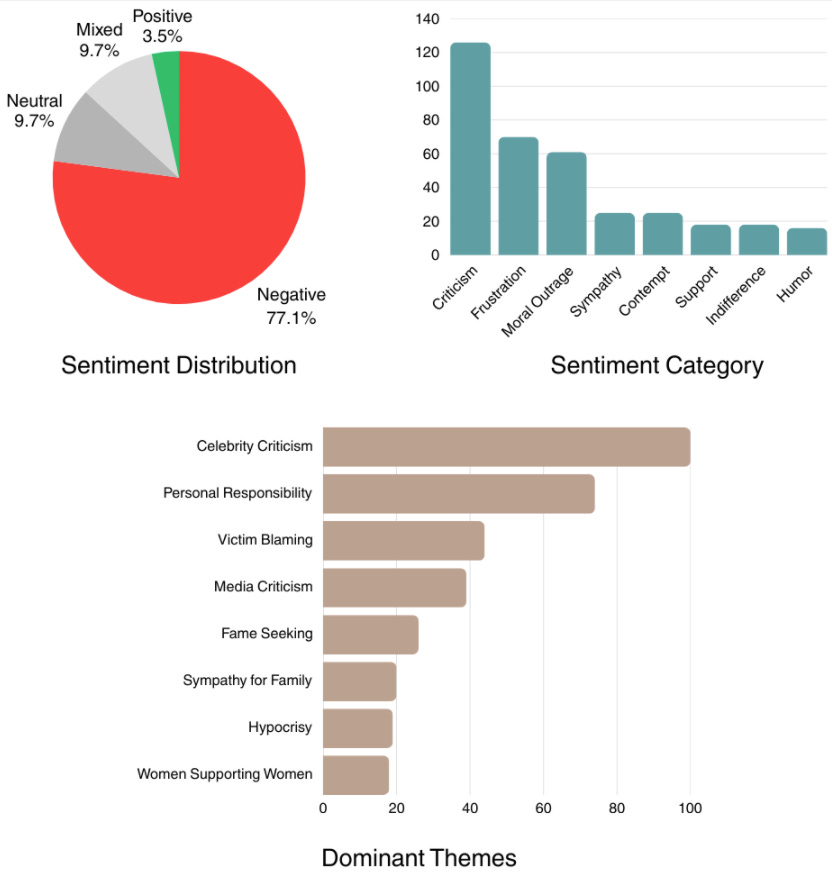
The comments are overwhelmingly negative, indicating that the public is largely unsympathetic to Cabot, with an emotional tone dominated by judgment. Commenters criticize Cabot’s actions, her decision to do the interview, and Oprah’s involvement. They express frustration that this story is still in the news and categorize it as Cabot’s attempt to extend her ‘15 minutes of fame’ (a risk of which Cabot indicated she was aware). They lean into moral outrage, condemning infidelity and highlighting the impact on the families involved. While sympathy is a common emotional tone in the comments, it is directed toward the spouses and children involved, not Cabot herself. Many commenters express contempt toward Cabot and a lack of respect for her attempts to reframe the narrative.
The dominant themes in the commentary highlight a demand for accountability and a rejection of celebrity culture, with many specifically targeting Oprah for platforming the story. Personal responsibility is the most relevant theme regarding Cabot herself, with the recurring argument that, as a consenting adult and Head of HR, she should accept the consequences of her public actions rather than blaming others. Commenters are actively pushing back against Cabot’s self-framing as a victim. Several suggest that Cabot is engaging in a PR campaign to monetize the situation or prolong her notoriety.
“She isn’t owed an apology from anyone; she (and her boss) was caught in public doing bad things that they BOTH knew was wrong. As a woman, she is calling out women but blaming her boss for supposedly telling her he was separating. If society could use social media to see that wasn’t true why couldn’t she.
She is missing the attention - this is just a ploy for more press. Disappointed that Oprah even gave her an avenue to get more attention.” — Comment from user IMHO
That focus on women supporting women? Barely commented on at all, and where it is, largely unfavorably.
Cabot’s message is real; I do believe that the ‘something positive’ she wants to achieve from this experience is awareness around the effects of online backlash. I also agree with what Molly McPherson said about not blaming the public when you’re criticized and that Cabot’s thinking might be missing the mark after Cabot’s December 2025 NYT article. But that’s besides the point, because regardless of whether I agree with her narrative, it’s what she’s doing that’s burying it herself that I want to help you avoid.
What went wrong?
The Timing
The original incident was in July 2025, Cabot’s first public statement (in NYT) in December 2025, and the Oprah interview in March 2026.
Cabot mentioned in the interview that a PR advisor told her to stay quiet, let time pass, and then speak, which isn’t wrong advice in isolation, but it only works if the silence is complete and the eventual reemergence is strategic. Cabot stayed quiet long enough for the story to begin fading naturally, and then reignited it herself. Twice. With herself as the victim of public backlash at the center.
The NYT piece, “The Ritual Shaming of the Woman at the Coldplay Concert,” was a little more focused on the systemic cruelty of internet backlash vs. Cabot’s personal narrative, unlike the Oprah interview. The latter may have brought anyone moved toward sympathy by the NYT article back to frustration over accountability. Cabot might want to bring attention to the effects of online backlash, but the danger in her approach is that it reignites the backlash itself right when people had almost forgotten about it.
Her timing is both too late and too early. Her current narrative and the negative response to it, if released closer to July 2025, would at least have been contained within the original backlash. As it is now, it’s bringing the original backlash back with little benefit to Cabot in terms of the issue she wants to highlight because she’s clearly still too involved in the fallout from that to separate what happened to her from the messaging she wants to spread moving forward.
When you do speak after silence, you need to be sure that what you’re saying is worth the cost of the attention it will attract. Attention is a double-edged sword when your name is still synonymous with a viral scandal. If it’s too soon for you to have been able to emotionally separate the effects of what happened to you from the learning you want to share, you’re at risk of pulling all the attention back to the original issue and having your ‘something positive’ categorized as an excuse or ‘spin’ to absolve you of responsibility for your original behavior.
There is also danger in perceiving the success of one public statement, media article, or interview, then getting ‘energized’ by that in a way that makes you want to do more prematurely and without sufficient strategy. One of my clients put out a public statement that was so well received that even I was surprised by the positive sentiment, and then wanted to add another to ‘finish’ the story. I spent hours looking at the content that was supposed to go into that piece and had to tell her we couldn’t use any of it because it would undermine everything the first one did and completely overshadow the rest of her messaging.
The Details
The Oprah interview is structured in three parts: the backstory of Cabot’s relationship with Byron, the night of the concert and its immediate aftermath, and broader reflections on online backlash and women’s treatment of other women. The first two parts are so long and so focused on Cabot’s personal experience that by the time we get to the third, the audience has already formed a judgment.
Cabot spends a significant portion of the interview explaining, in granular detail, how her relationship with Byron developed. Every detail she gives is a gift to the people who want to make memes out of her. Her revelation that Byron may not have actually been separated (“a lot of what was represented to me was not true”) comes across as an attempt to win sympathy. This type of detailed discussion happens when we think that if we can just explain the context clearly enough, people will understand and forgive and leave us alone. It’s a misjudgment that lack of information is the cause of the backlash. In this case (and maybe yours, depending on what you’re working with), the public isn’t reacting to a lack of information but the moral judgment they’ve made based on the situation itself. More information about the circumstances of the relationship doesn’t change this; it gives them more material to argue with.
The qualified accountability
Cabot does say, repeatedly, that she made a mistake, with apparent sincerity… But.
The acknowledgment is almost always followed by a ‘but’ sentiment. She made a mistake, but she was separated. She made a mistake, but he told her he was separated too. She made a mistake, but she “didn’t hear Chris Martin say we’re going to pan the audience”. She made a mistake, but she would have turned away from any jumbotron because she’s “not a jumbotron girl.”
This is counterproductive because it tells your audience you haven’t fully accepted responsibility and are still somewhat negotiating with the verdict.
If you want to share what you’ve learned about a situation where you’re perceived to be responsible, you cannot achieve focus on what you want your audience to be thinking about if you don’t lead with accountability. The focus will stay on your lack of accountability.
The blame-shifting
Perhaps the most self-defeating moment in the Oprah interview is Cabot’s focus on Gwyneth Paltrow and Ryan Reynolds. After the scandal, Astronomer’s new leadership leaned into the chaos and worked with Reynolds’ marketing company, Maximum Effort, to produce a deadpan ad for Astronomer with Paltrow. Much of the sentiment around this ad indicated that it was perceived as clever and self-aware. A win for Astronomer.
Cabot tells Oprah she was disappointed in Paltrow, whose brand is built on uplifting women. She calls the ad hypocritical and unnecessary, adding that she doesn’t want to “let Ryan Reynolds off the hook either,” noting that his wife Blake Lively “has just gone through something really similar over the last year” (I’m still trying to grasp exactly what the similarities are that Cabot is referring to here and could potentially write an entire article on that one comment).
This is how to make yourself look bad while trying to make a point.
Paltrow and Reynolds are not the villains of this story. Astronomer hired them to make a marketing joke. Cabot quite effectively shifts the public’s sympathy away from her and toward the celebrities she is criticizing, making her advocacy look personal rather than principled, as if the real issue is not online cruelty in general but the specific people who she feels wronged her. She also blames them but not explicitly Astronomer for how they handled (or, rather, didn’t) the backlash.
Cabot’s quick remark about how she’s “not the biggest fan” of Coldplay anymore and how this incident “ruined” them for her may have been intended to come across as a little light humor, but when you pair it with her later, much more seriously phrased comment on how she didn’t hear Chris Martin say that the jumbotron was panning the audience suggests that she is on some level shifting blame to Coldplay. That she didn’t know she might be seen implies that it’s being caught that she’s concerned with, not what she was doing, coming back to that lack of accountability.
The ‘women supporting women’ narrative
Cabot’s description of the gendered nature of the backlash she received is emotionally resonant. She describes women approaching her in public to harass her. She describes it as more devastating than almost anything else, learning how “unwell we are as a gender,” as she puts it. There is research (one example) showing that women police other women’s sexual and romantic behavior more harshly than men do. The ‘other women’ in cheating scandals tend to be more of a target of public rage than the men who cheated. So the double standard is real and worthy of discussion.
But Cabot’s framing of it undermines the point she’s trying to make because she presents the women’s anger as irrational, a kind of collective psychological dysfunction and a projection of their own fears onto her. She says she wants to sit down with some of these women and “really listen and try to understand what it is about me or what it is.” And it doesn’t seem like an inviting conversation.
Painting this anger as irrational and as though it is about Cabot personally ignores the fact that it stems from empathy for Byron’s wife and for every woman in that position. When Oprah gently points this out, noting that Cabot became “the face of the woman who took my husband” for a lot of women who have been cheated on, Cabot acknowledges it intellectually but does not seem to fully absorb it emotionally, saying, “they don’t know me. It can’t really be me, but it’s something I represent.”
If you want to talk about why women attack other women online, you have to be willing to acknowledge the legitimate grievance underneath their response. You have to say, “I understand why women who have been betrayed by their partners saw themselves in Andy Byron’s wife. I understand why that pain was directed at me.” You can’t alienate the group you’re trying to advocate for.
Cabot never quite gets there. She keeps pulling back toward her own hurt feelings, which makes the audience feel like the empathy she is asking for is for her and not for women in general.
A different approach
Doing this well and shifting from ‘person at center of scandal’ to ‘advocate for issue related to scandal’ requires accepting the counterintuitive truth that the more you try to clear your name, the more you keep your name in the story; the more you focus on the issue, the more your name fades into the background.
And this is exactly what you need if you want people to hear your message.
Start with a brief, unqualified acknowledgment of the mistake (none of the “I made a mistake but” statements, just “I made a mistake”). Explicitly acknowledge the harm done (e.g., in this case, to Byron’s wife) as a genuine expression of remorse. Then move directly to the issue itself. Cabot could have talked about the mechanics of how a 15-second clip becomes 300 billion views, the financial incentives that platforms have to amplify outrage, the documented reality that women bear a disproportionate share of internet mob justice, and the concrete, terrifying consequences for real families…
When you stop centering yourself as the subject of the discussion and start being the messenger for what you’ve learned, you’re speaking to your audience in a way that’s going to help them see you as a person telling them something they need to hear, not a person they need to judge. Focus on other people’s experiences and how those factor into the issue you are highlighting, so the narrative is built on the broader effects of the issue and not on you and how it specifically affected you. This is how you show that the issue is larger than you, and it will land better.
The People Magazine comment section shows where Cabot went wrong in the themes that came up around personal responsibility, victimhood, criticism, frustration, and moral outrage. This is an audience that felt manipulated. They wanted advocacy, something larger than Kristin Cabot’s personal narrative, and got… more of Kristin Cabot’s personal narrative. They felt the advocacy framing was being used as a shield rather than a genuine cause.
That is the biggest risk when you go into advocacy after a public scandal. When you’ve made a public mistake and want to use that experience to say something meaningful about the systems involved in that mistake, you cannot be the victim and the advocate at the same time. The moment you are asking for sympathy for yourself, you are no longer asking people to think about the issue. You are asking them to think about you. And if they are already predisposed to judge you, that is a fight you will lose every time.
You have to separate your personal experience from the cause you want to champion, or you end up with a real cause and a messenger who keeps getting in the way of it.
Stop asking whether you deserved what happened to you and start asking whether anyone deserves it, then lead with that.