


The first rule in crisis communications (in fact, any communications or public relations strategy) is know your audience.
The way you communicate a new initiative, especially one that touches on sensitive and potentially life-or-death issues, is as important as the policy itself. And if your messaging alienates the very people you are trying to protect, your initiative is dead on arrival.
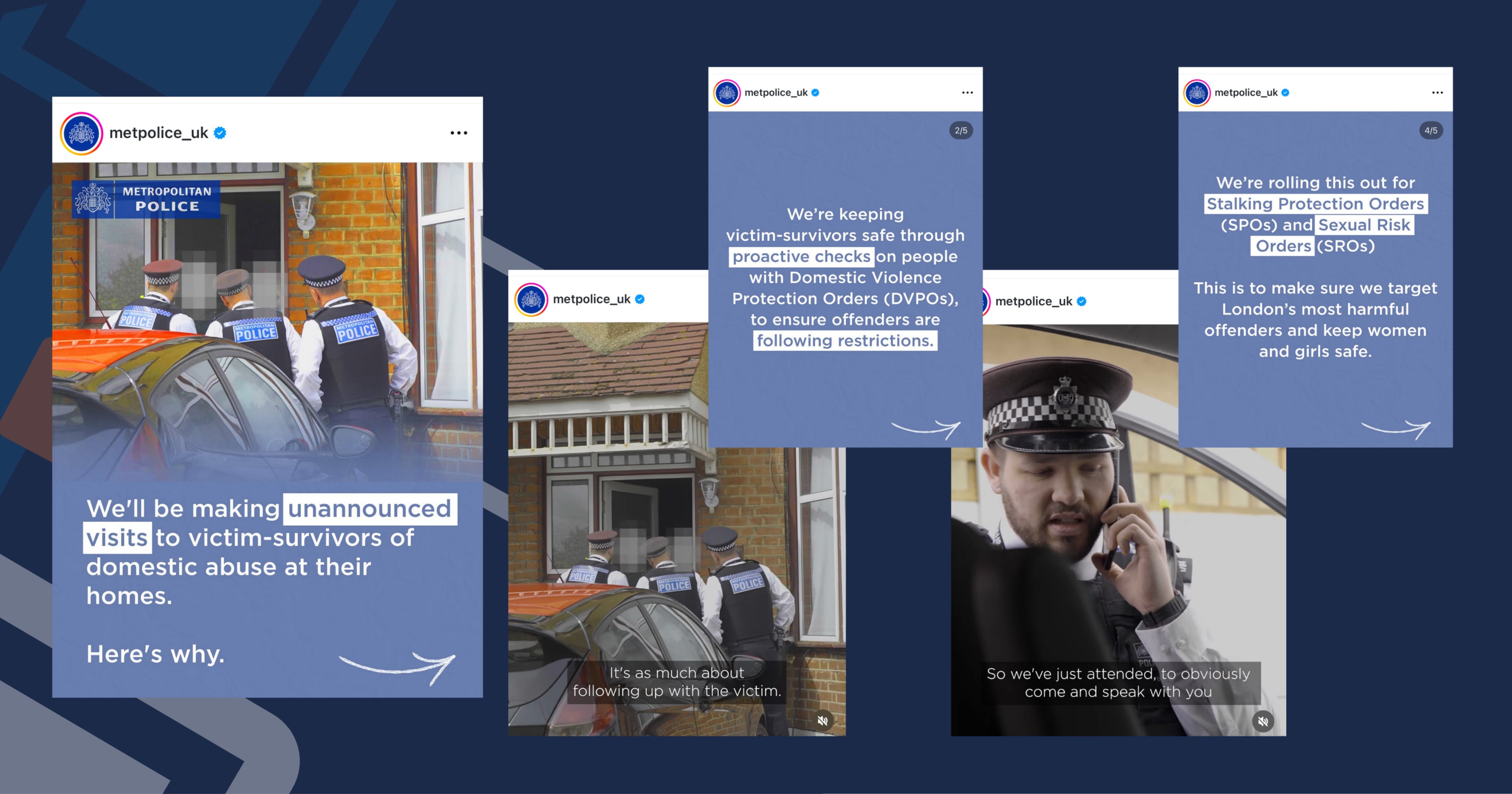
Take this messaging from the London Metropolitan Police Service (the Met) as an example of how NOT to communicate a sensitive policy. This Instagram post below is their announcement of Operation Sallus, a force-wide initiative designed to better enforce Domestic Violence Protection Orders (DVPOs). A part of this operation involves making unannounced visits to the homes of domestic abuse victim-survivors to check if offenders have breached their restrictions.
Predictably, this messaging hasn’t gone over well:
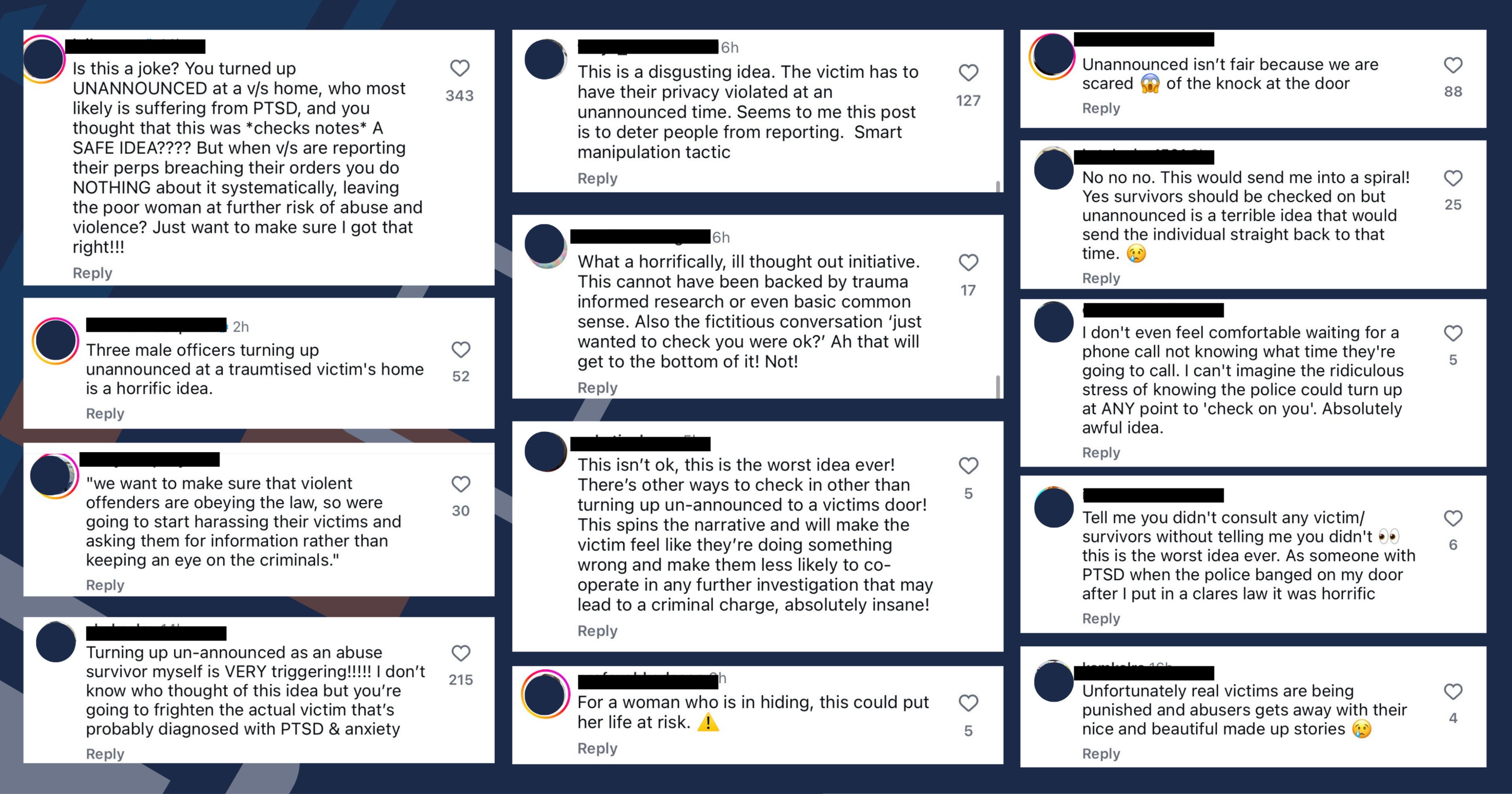
But what’s wrong with it?
Let’s have a look at the Met’s social media presentation and why the messaging provoked backlash, how it fundamentally misunderstood the psychology of its stakeholders, and what a better approach would have looked like.
The Initiative
Operation Sallus was rolled out across every London borough with the stated goal of taking a proactive approach to enforcing DVPOs, which are civil orders used by police when there isn’t enough evidence for a criminal trial or when a victim isn’t ready to support a prosecution. These DVPOs can ban perpetrators from contacting victims or returning to their homes for up to 28 days, and have been criticised extensively by survivors and charities such as Refuge for being poorly monitored and rarely enforced.
Operation Sallus was developed to change this. Detective Chief Superintendent Andrew Wadey told The Independent:
“It’s an in-person visit by local officers, and the intention there is to hopefully speak to the victim and ascertain if there’s been any further issues. Is the offender there, do they need any kind of referrals or signposting to support agencies and essentially just take a really sort of victim-led approach to providing assurance, reassurance, and another avenue towards reporting any kind of breaches or concerns.”
On paper, this sounds like a positive step as it addresses the long-standing criticism around lack of efficacy; however, the execution (particularly the communication around it) indicates a massive blind spot in the decision-making process surrounding survivor safety and trauma.
The Social Media Execution
The caption on the Met’s Instagram post (see above) reads: “Rape arrests and domestic abuse charges more than doubled across London last year. With victims at the heart of our approach, officers are taking proactive action to safeguard them and target dangerous offenders. Click the link in our bio to find out more about reporting domestic abuse”
From a crisis communications perspective, the Met’s social media strategy failed on several critical fronts:
The Weaponisation of the “Unannounced” Element
The prominent highlighting of the phrase “unannounced visits” on the first slide reads as threatening and an almost boastful display of power. For many (most?) domestic abuse survivors, unpredictability and loss of control are substantial elements of the trauma endured, as abusers often function by keeping their victims off-balance.
Announcing that police will now be showing up at survivors’ homes without warning, leading with this and highlighting the unannounced nature of the visits in a prominent way in their first slide, the Met have (presumably inadvertently) replicated the dynamics of abuse. This slide focuses on operational tactics at the expense of the psychological safety of survivors, despite the fact that survivors are the key stakeholder group in this messaging.
An unannounced knock at the door could trigger a severe trauma response in a survivor, and even when they realise it’s the police and not their abuser, that sudden intrusion into their safe space can feel like a violation, which the messaging has completely failed to acknowledge.
The Intimidating Visuals
The imagery chosen to accompany the text exacerbated the problem. Slide 2 shows three male police officers, viewed from behind, surrounding a residential door. The Met probably intended this to convey the strength of their proactive protection, but it actually conveys intimidation. Three uniformed men arriving unannounced at a home can be a terrifying prospect, particularly for marginalised communities or those who have had previous negative interactions with law enforcement.
Broadcasting Tactics to Abusers
Domestic abuse is about coercive control, so abusers constantly monitor their victims and look for ways to manipulate situations to their advantage. An abuser who sees this post now knows that the police might show up at their victim’s house, and they can weaponise this knowledge. They might threaten to harm the survivor if they share anything when the police show up. Worse, if an abuser is illegally present at the home when the police arrive, the situation could escalate into violence.
This post essentially compromised the operational security of the initiative and put survivors at risk for the sake of a PR win (“Look, we’re doing something!).
Failing to Understand the Key Stakeholder
The root cause of this communications disaster is the failure to understand the primary stakeholders: the victim-survivors of domestic violence. Effective communication requires empathy and a deep understanding of the needs, motivations, fears, and desires of your audience.
The Met’s messaging demonstrates a lack of all four.
The Trust Deficit
The Met Police currently operates under a massive trust deficit, particularly regarding violence against women and girls. The 2023 Baroness Casey Review found the force to be “institutionally racist, misogynistic and homophobic”. The horrific rape and murder of Sarah Everard by a serving officer, and the unmasking of David Carrick as a serial rapist within the ranks, have shattered women’s confidence in the police. In this context, the Met cannot assume that their presence is inherently welcomed or viewed as protective by women. Many survivors fear the police as much as they fear their abusers and worry that they will not be believed, that they’ll be judged, or that the situation will be escalated against their will.
The formatting of the text on the first slide could easily be read as having more sinister connotations by someone who is on high-alert and not trusting the police. When we don’t have all the information about why something is happening, we have a tendency to fill in the blanks with the worst-case scenario (this is human nature, we all do it, and not even intentionally, it’s just the survival instinct). Someone in a traumatic situation who fears not being believed might see this:

…and add onto it “because we don’t believe you and want to check up to make sure you are telling the truth and you aren’t doing anything wrong.” OR “If you report the situation you’re in, we’ll be showing up unannounced, so… are you sure you want to do that?”
The Operation Sallus messaging ignores the context and assumes a baseline of trust that simply… doesn’t exist. You can see this in some of the comments on the Instagram post, with one user saying, “Seems to me this post is to deter people from reporting. Smart manipulation tactic.” There’s institutional arrogance in there.
We’re the police, we’re here to help, and you should be grateful we’re showing up.
But survivors of domestic violence are the foremost experts on their abusers, and they know what will trigger violence and what will keep them safe. Often, survivors choose not to report breaches of DVPOs because they calculate that police involvement will enrage the abuser and escalate the danger. The Met’s “proactive” approach strips the survivor of their agency, and the showing-up-unannounced aspect takes the risk assessment out of the survivor’s hands. The messaging does absolutely nothing to address this fear. It doesn’t explain how the police will ensure the victim’s safety if the abuser finds out about the visit, or if the visit itself triggers a violent retaliation.
Trauma recovery requires restoring a sense of agency and control to the survivor, which requires partnership with the police and others in supportive roles but “We’ll be making unannounced visits” is a statement of power that tells the survivor that they don’t have any say in when they have to engage with the police and focus on their situation. Trauma-informed care prioritises transparency and consent. This is neither of those things.
Poor Comms or True Character?
So, does this bad messaging indicate a lack of effective communication skills, i.e., a good thing communicated badly, or does it reveal the true character and beliefs of the entity, i.e., a bad thing exposed by poor communication?
Given the Met’s history and the findings of the Casey Review, it is difficult to dismiss this as a clumsy PR mistake, since the messaging mirrors the ingrained institutional mindset we’ve seen in the past, one that prioritises enforcement metrics and operational convenience over the realities of victim–survivor trauma.
The post reads like it was written by cops, for cops. Not for survivors. Not even to scare away abusers thinking of breaching orders. It highlights “proactive action,” “targeting dangerous offenders,” and “enforcing restrictions”, suggesting that the Met still views domestic violence primarily as a crime to be policed, rather than a complex situation that requires a measured and survivor-centred approach.
It’s also highly performative, using survivors as props to demonstrate that the force is “doing something” about violence against women and girls, while demonstrating a complete lack of genuine understanding. My take is that it’s a PR exercise designed to improve the Met’s reputation, but it’s done in a way that further damages it by revealing that the underlying issue is still there. This is bad communication exposing a persistent issue.
They prioritised the appearance of action over the impact of that action on the key stakeholders. A well-intentioned initiative at some stage, perhaps, but those good intentions got left in the decision-making room well before the policy was finalised and made it to the socials. The strategy itself would have been different if the decision-makers had taken an approach that centred the real stakeholders and not the Met’s PR.
How to Communicate Sensitive Initiatives
Could the Met have communicated Operation Sallus effectively without alienating its key stakeholders? Potentially, with a trauma-informed, stakeholder-centric approach. Here are some considerations for how this could have been done better:
Consult Before Communicating
Before drafting a single post or press release, consult with the people who will be most impacted by the initiative.
In this case, the Met should have engaged extensively with domestic abuse survivors, advocacy groups (like Refuge or Women’s Aid), and trauma specialists. If they had presented the “unannounced visits” concept to a panel of survivors, the feedback would likely have been immediate and unambiguous: Do not do this, and definitely do not announce it on Instagram.
Stakeholder consultation is an essential risk-mitigation strategy that helps you identify blind spots and unintended consequences before they become PR disasters.
Check The Framing
The framing of the initiative needs to be centred on the benefit to the key stakeholders. What is this going to give them? Why should they want it?
The Met’s messaging shouldn’t have used the tactical language of “unannounced visits” and “enforcement”. It should have used the language of support and partnership. The messaging should have focused on the purpose of the initiative, i.e., ensuring the burden of reporting doesn’t fall solely on the survivor. So, for example, they could have said:
“We know that reporting breaches of protective orders can be dangerous and exhausting. That’s why we are taking on more responsibility to ensure offenders comply with the law. Our specially trained officers will be conducting regular compliance checks to support your safety.”
(That’s assuming this unannounced visit concept should have made it as far as it did; it shouldn’t, but the above would have been a better way to communicate it, given that it does exist.)
Emphasise Agency and Choice
Trauma-informed communication must prioritise the survivor’s agency. The Met needed to communicate that they understand the risks involved and that the survivor remains in control.
The communications should have clearly outlined how victims could opt out of these visits or establish safe protocols for contact. For example:
”We will work with you to determine the safest way to conduct these compliance checks. If a home visit is not safe for you, we will find alternative ways to ensure the order is being followed.”
No Performative Social Media
Some initiatives do not belong on Instagram. A tactical operation designed to catch domestic abusers off-guard is one of them.
Turning Operation Sallus into content trivialises the danger, and it shouldn’t have been used to garner “likes” or prove to the public that the Met is tough on crime. The correct approach would be to confidentially and safely inform survivors that this support is available through targeted, discreet communication. Through independent domestic violence advisors, community groups, and local charities, perhaps. With the social post as it stands, there’s a real risk that someone wanting to report domestic violence today will be put off doing so at the prospect of receiving an undetermined number of unannounced home visits afterwards and what those could mean for their situation if they know their abuser will use it against them.
Address the Trust Deficit Head-On
The Met can’t communicate effectively about violence against women and girls without acknowledging their own history and the criticism they’ve faced. Acknowledging the trust deficit is the first step toward repairing it.
The messaging could have included a humble acknowledgment:
“We know we have a long way to go to rebuild trust with women in London. We know that police presence isn’t always a source of comfort. We are implementing this initiative carefully, with specialised training, to ensure we are truly prioritising your safety above all else.”
The Broader Lesson: Stakeholder Empathy as a Strategic Imperative
The Operation Sallus PR disaster is a reminder to any organisation that you can’t communicate effectively if you don’t understand the people you’re talking to. When you launch an initiative, especially one with a high potential for issues, you must ask yourself:
Who are the primary stakeholders?
What are their lived experiences?
What are their fears, motivations, and desires?
How will this message be received through the filter of their trauma or their past experiences with our organisation?
Are we prioritising our own PR goals over their actual well-being?
If your messaging alienates your stakeholders or feels threatening, tone-deaf, or performative, it doesn’t matter how well-intentioned your initiative is or much data you have to support your policy. The initiative will fail.
The Met Police wanted to show London that they were taking domestic violence seriously, but in failing to understand the terrifying reality of unannounced visits for a survivor and prioritising a social media announcement over operational security, they demonstrated that they still have a profound lack of empathy for the people they claim to protect.
Empathy is a strategic imperative. Without it, you’re not communicating.
Sources
Instagram:
Casey, L. (2023). An independent review into the standards of behaviour and internal culture of the Metropolitan Police Service [Report]. Metropolitan Police Service. https://www.met.police.uk/SysSiteAssets/media/downloads/met/about-us/baroness-casey-review/update-march-2023/baroness-casey-review-march-2023a.pdf
Couture-Carron A, Saulnier A. "That Came Back to Haunt Me": Violence Against Women Survivors' Concerns About Police Use of Body-Worn Cameras. J Interpers Violence. 2026;41(1-2):345-371. doi:10.1177/08862605241311610
Futures Without Violence. (n.d.). Reimagining survivor safety: An alternative response to domestic violence. https://www.futures-institute.org/reimagining-survivor-safety-an-alternative-response-to-domestic-violence
Martin, A.-C. (2026, May 20). Operation Sallus: Inside the Met police mission to protect victims of domestic violence. The Independent. https://www.the-independent.com/news/uk/crime/vawg-domestic-violence-met-police-operation-sallus-b2978654.html
U.S. Department of Justice, Office on Violence Against Women. (n.d.). Domestic violence. https://www.justice.gov/ovw/domestic-violence
U.S. Department of Justice, Office of Community Oriented Policing Services. (n.d.). Victim-Centered, Trauma-Informed Practices https://portal.cops.usdoj.gov/resourcecenter/content.ashx/cops-r1184-pub.pdf
Women’s Aid. (n.d.). Coercive control. https://womensaid.org.uk/information-support/what-is-domestic-abuse/coercive-control/