


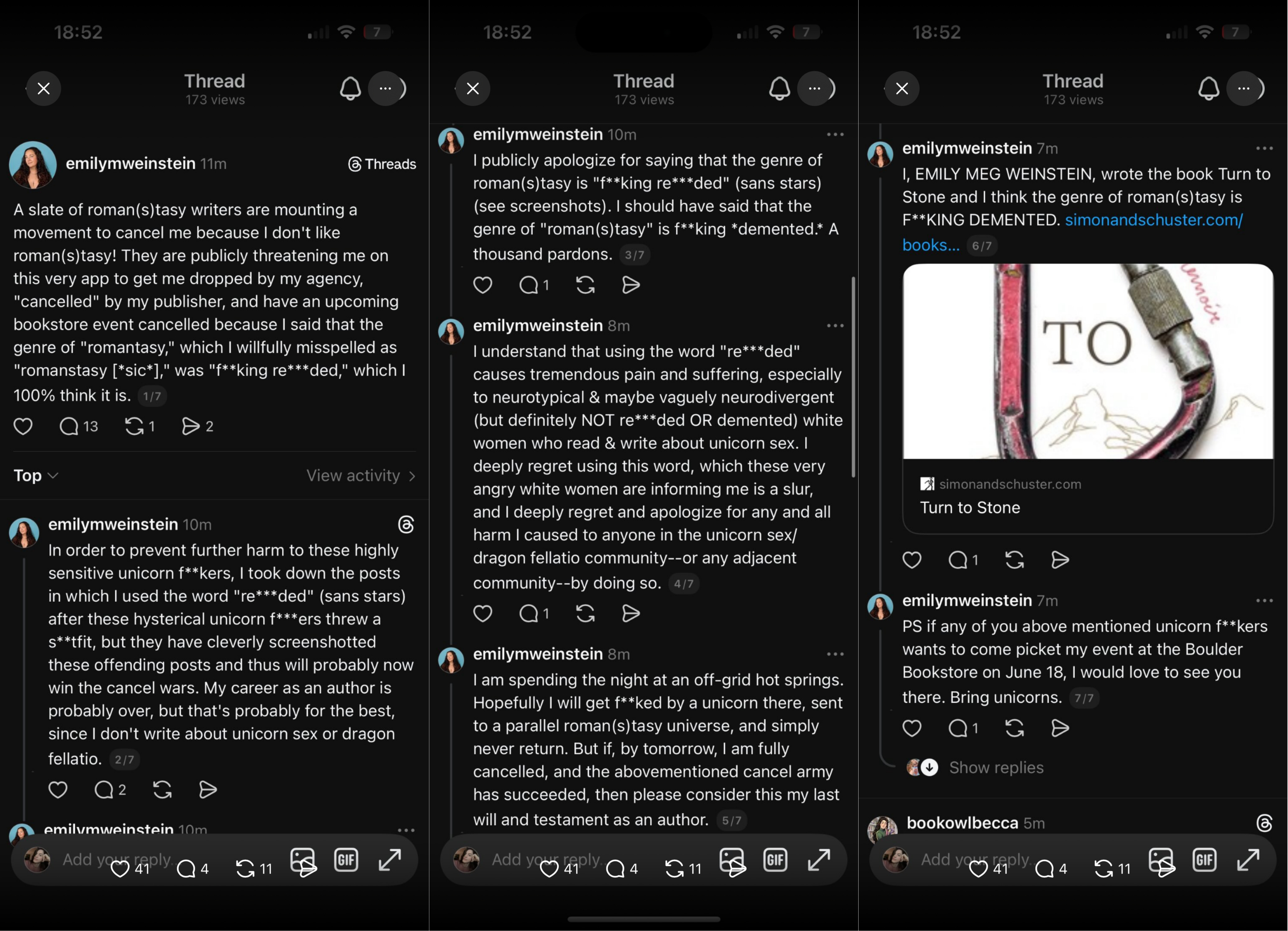
The original post on Threads is gone, but as always, users have screenshots (you can’t delete your way out of viral rants). Author Emily Meg Weinstein posted a thread purposefully misspelling the word ‘romantasy’ (a book genre blending romance and fantasy, to save you looking it up like I had to), someone corrected her, and she responded with this:
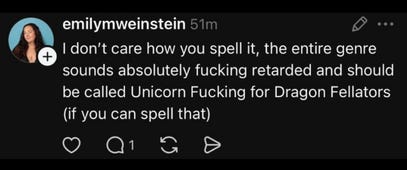
It only got worse from there:
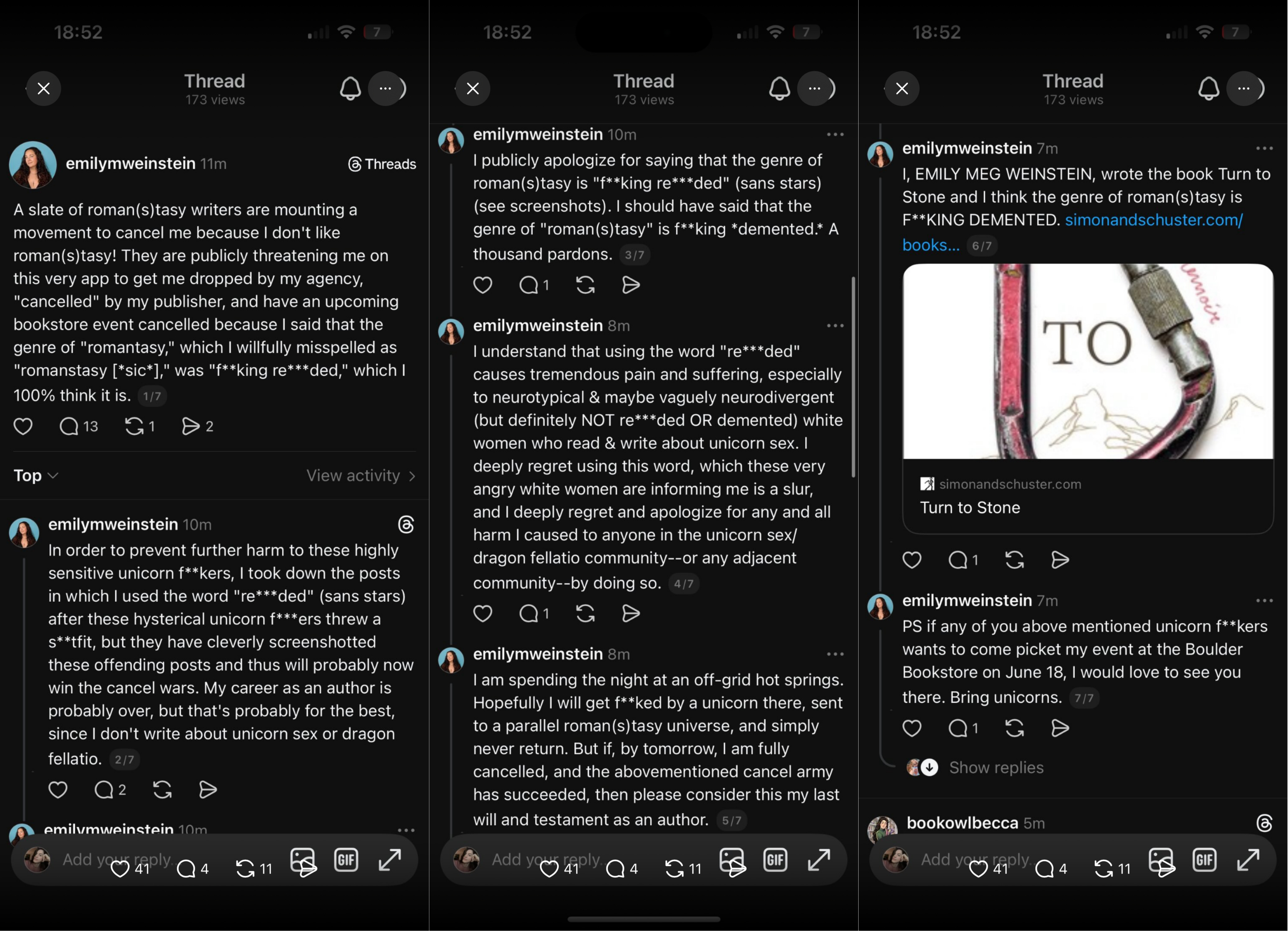
Her feelings are pretty clear. Then, we get this:
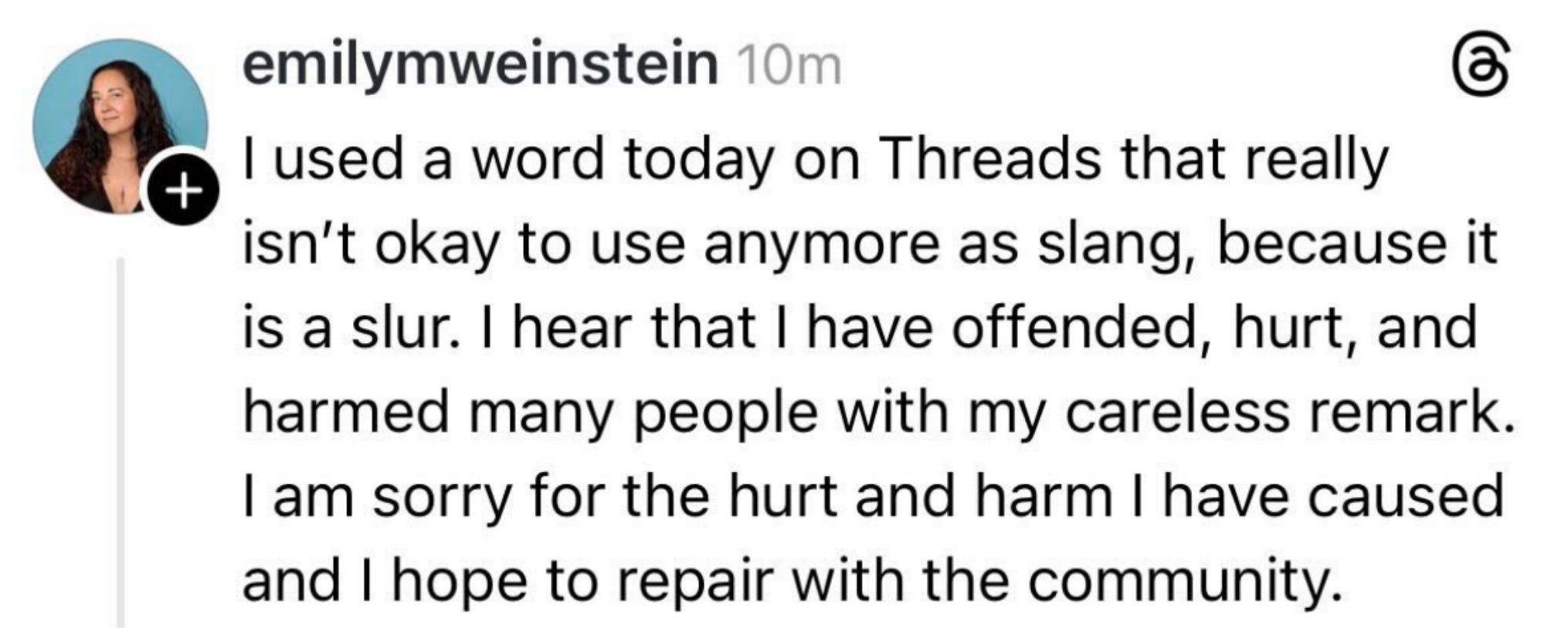
These are the words of a person who did a bad thing and then got bad advice.
We don’t know exactly what prompted Weinstein’s angry rant. What we do know is that what Weinstein did is exactly what not to do when facing online backlash. This is an example of how a (relatively) minor misstep can be escalated into a career-threatening catastrophe by the combination of ego and defensiveness. The initial response to the correction of a misspelling is where this all fell apart into a mocking faux-apology and shameless self-promotion, followed by a sterile (likely publisher-mandated) PR apology that I’m guessing nobody is taking as authentic.
Inciting Incident to Escalation
To understand the magnitude of any crisis, we need to look at the inciting incident and subsequent escalation. The controversy began innocuously enough, with Weinstein spelling ‘romantasy’ as ‘romanstasy’. Perhaps an attempt at rage-baiting; though Weinstein likely did not intend to rage-bait herself, that is ultimately what she did. In her response to being called out for the misspelling, she responded with ableist language, contempt for the consumers of an entire genre, and absolutely unnecessary aggression. If she had stopped at that one post response, she might have been able to later recover that with a well-formed apology (which the one she eventually produced is not); however, when she doubled down and wrote that multiple-post ranting fake apology? That removed the possibility for remaining goodwill.
Instead of stepping back, Weinstein leaned into the controversy and demonstrated aggressive victimhood. She attempted to reframe the narrative to one where she’s not ‘the aggressor who used a slur’, but ‘the victim of cancel culture’, defensively demonstrating contempt for the audience and swapping the slur she used for another offensive term (‘demented’), indicating that her initial use of it was a reflection of her genuine attitude. This paragraph is dripping with condescension. She mocked the concept of harm and belittled the people calling her out, continuing to use derogatory language to describe the romantasy genre. If you want to alienate people, this is how you do it.
Romantasy readers might not be Emily Meg Weinstein’s audience. But when your words cross into a different audience, those voices have the power and influence to control the narrative and bring that narrative to your audience. They matter. Especially if you’re going to link your audience with the controversy by promo-ing your book, linked to your publisher’s website, at the end of an angry rant with “I, EMILY MEG WEINSTEIN, wrote the book Turn to Stone and I think the genre of roman(s)tasy is F**KING DEMENTED” attached to it.
Attempts to leverage negative attention as a marketing opportunity indicate a complete lack of listening to the core issue, and it’s hard to come back from that.
When PR Apologies Go Wrong
What I’m mainly interested in in this situation is what happened between Weinstein’s angry rant and the subsequent apology that appeared before she deleted her account. The apology was no doubt mandated by her publisher. But did anyone help her write it? It is sterile, vague, and a complete contrast to the sarcastic voice that characterized the posts she made on the same day. That was never going to work. This is not how good apologies work.
A ‘bad’ statement indicates either a lack of effective communication skills or reveals the true character and beliefs of the individual. Weinstein’s initial response suggests the latter; those posts read as a sustained, deliberate expression of contempt, and she had multiple opportunities to de-escalate, choosing not to. The second statement is impossible to take seriously because it directly contradicts the ‘true character’ she had just spent the day aggressively displaying. Issuing an obviously performative apology when you have just demonstrated negative behavior essentially confirms a lack of genuine concern, because the audience is not stupid. They can spot the difference between sincerity and a panicked response to being told you have to apologize by a publisher.
Notably, the second response made no attempt to correct the first response, only focusing on the initial use of the word. It ignored the context of the preceding rant. There was no attempt to address the contempt shown for the people she had offended, and for an apology to be effective, it needs to show empathy and focus on de-escalation. When you have caused harm (regardless of whether you did so intentionally), the first step is to acknowledge that harm and validate the feelings of those affected.
Weinstein did the exact opposite before issuing the apology in a way that makes that apology completely inappropriate for her situation. She called it a ‘careless remark’, but her previous posts indicate that it was a deliberate. She repeated it, defended it, and blamed the audience for their reaction to it. You can’t mock the idea that your words could have caused pain and belittle the intelligence of your critics in one post and then expect them to accept an apology for the initial transgression in the next.
Then she deleted her account. Now, when you look for her on Threads, the primary thing you see is other people talking about the situation and sharing screenshots of it. So she messed up, apologized incorrectly, then left the narrative to be continued by everyone else.
If you are in a situation where you need to apologize for something, it is absolutely critical that you accurately assess the situation and issue an apology that is appropriate for the context in which you are apologizing. Otherwise, you will make your crisis worse. Your apology will become a new crisis that exacerbates the previous one.
How I’d Have Handled This Differently
If Emily Meg Weinstein had been my client, here’s the approach I would have taken (a) if we were intervening after the first post and (b) if we were intervening after the full rant.
(a) Response if you’re at this stage (single bad post with backlash; potential for escalation):
1. STOP DIGGING (CONTAINMENT)
The first rule when you end up in a hole is to stop digging. The moment the initial backlash began over the use of the slur, Weinstein needed to step away from the keyboard.
Do not reply.
Do not defend yourself.
Do not post anything else.
The escalating thread tipped the edge in this case. Had she simply posted the initial offensive remark and then gone silent, the crisis would have been contained to a single, albeit serious, mistake. The escalation transformed a mistake into a character indictment, and the PR-sounding apology made it worse. That did not need to be issued (a) when it was and (b) with that specific content. Speed is imperative; however, it’s a mistake to rush to an apology when the person isn’t ready to do it properly and doesn’t have a full grasp on what they’re apologizing for and why, or what they actually did and why.
Waiting is better than having to issue an apology for an apology
2. ASSESS THE SITUATION AND THE WHY
Before drafting an apology, you need to understand the scope of the damage. Assess the sentiment, identify the key stakeholders (the neurodivergent community, the romantasy community, her publisher, her agency), and determine the core offense.
You need to have an honest conversation about the why of what you did. An apology cannot be sincere if you don’t understand why of the apology and the reasoning behind what you did. If Weinstein truly believed the things she wrote, no PR strategy in the world could save her. But a conversation that develops an understanding of where those feelings came from could uncover something that she didn’t really mean, an inciting incident that made her defensive, stress… anything that explains where it came from that moves the position from defensiveness to empathy and produces the starting point for a genuine apology.
You have to understand why you did what you did and what the specific impact of it was before you can construct an authentic apology
When you’ve done something that requires an apology but also requires sufficient time for reflection for your audience to believe that the apology is sincere, a two-part approach is better.
First, as soon as possible, issue a pre-apology holding statement, e.g., I recognize that my post today was deeply offensive and harmful. I am stepping away to seriously reflect on my actions and will address this fully when I have taken the time to understand the damage I have caused.
Then, take the time to get a full understanding of your situation and draft the sincere apology.
3. A REAL APOLOGY
The PR statement Weinstein posted was too generic. A genuine apology contains four essential elements:
Acknowledgement: Name exactly what you did wrong without minimizing it
Accountability: Specific accountability, with no excuses, no “I'm sorry if…” statements, and definitely no blaming ‘cancel culture’. Demonstrate that you understand exactly what the impact of your actions was and that you accept responsibility for that impact.
Explanation: State why you did it. Put the offensive behavior in the honest, broader context to help the audience understand it (even if they won’t necessarily like it). Did you get angry after seeing romantasy authors outselling you because it’s a more popular genre, then attack the readers of that genre out of fear, insecurity, and concern that you wouldn’t be successful? Say so. It’s not good, but neither is what you’ve already done. People respect an honest explanation that makes you look bad more than they respect deflection that tries to make you look better.
Commit to change: Explain what you will do to ensure it doesn’t happen again. You’re taking time away to listen and learn. This needs to be specific and directly tied to what you would need to do to rebuild trust with your key audience and the stakeholders affected by your actions (these might be different groups). And it needs to be achievable. Do not over-commit and make promises you know you can’t keep. If you make a commitment to not attacking people online again knowing that you’re likely to go on another angry rant next week because you haven’t yet mastered the emotional regulation to stop yourself, promise to work on your emotional regulation, not that you won’t go on any more angry rants.
If we had contained the situation after the first post, the apology might have looked something like this:
Earlier today, I responded to a spelling correction with anger and used a deeply offensive ableist slur. There is no excuse for using that word, and I am profoundly sorry. I let my ego and frustration dictate my response, and in doing so, I caused real harm to the neurodivergent community and insulted a massive community of readers and writers. It was unacceptable, unprofessional, and cruel. I take full responsibility for my words. I am stepping away from social media to reflect on my behavior and educate myself on the impact of the language I chose to use. I apologize unreservedly to everyone I hurt.
But what about what happened between the escalation after that first post and the sterile apology? How do you approach this when you failed to stop digging?
(b) Response if you’ve already escalated substantially:
The crisis has mutated. It is no longer focused on the initial slur but the sustained aggressive reaction. If I had been working with Weinstein from this point, the strategy would have been very different from a standard apology. When you’ve escalated like this, a simple text post is no longer viable.
1. IMMEDIATE HOLDING STATEMENT
Do not post a full apology yet. It will not be believed. Post a holding statement that acknowledges the severity of the situation, for example:
“My behavior on this platform today has been unacceptable and deeply offensive. I am taking down my recent posts because they are harmful, but I am not hiding from what I said. I am stepping away from social media immediately to seriously reflect on my actions and the anger that drove them. I will address this fully when I have taken the time to truly understand the damage I have caused."
2. DELETE THE POSTS; NOT THE ACCOUNT
Delete the offensive posts to stop the active harm (the harm to the people they hurt, not to you), but leave the account active with the holding statement pinned. Deleting the account entirely, as Weinstein eventually did, comes across as evasion.
3. GET OFFLINE
No posting, no liking, no public appearances. This period could last weeks, not hours, depending on the situation and how much time you need to do the reflection that will allow you to respond sincerely. The public needs time to cool down, and you need time to listen and learn.
4. WELL-TIMED COMEBACK
The return after a situation like this needs to be deeply reflective (for a writer, this could be an essay) and explicitly address the entire situation. Here, she must explain why she reacted with such vitriol, acknowledge the arrogance and contempt she displayed, and outline the specific, tangible steps she has taken to change her mindset. You have to own the whole thing rather than focusing on the initiating event.
This is a slow process. Rebuilding after burning your reputation down takes time and requires patience. All rushing it will do is make it take longer. The timing is extremely important. We need a fast acknowledgement, hence the holding statement, but a fast attempt at a full apology just comes across as following orders. The rushed apology that failed to address the main concerns, followed by account deletion, instead of pinning a clear, acknowledgment-, accountability-, and learning-focused holding statement and stepping away with the account intact, guaranteed that the apology would be rejected.
Internal Communications
If I were working with a client who had done something like this, we’d also work on drafting internal communications with their agent, editor, and publisher. Those would also need to be strong in accountability, explanation, and a clear path moving forward to ensure that it won’t happen again. These communications must acknowledge the embarrassment you have caused them and assure them that you’re taking it seriously. Depending on the situation, they might want to protect you, but their PR and their motivations will most likely be to protect their brand from the backlash you have created. There’s no guarantee that handling this well will prevent negative consequences, like losing your agent or publisher, but not handling it at all will likely force the publisher and agency into a corner, leaving them with little choice but to distance themselves.
The consequences of doing something like this can be severe, and how effective you can be in the rebuild phase as you work to recovery your reputation hinges on how well you handled the initial fallout. It’s hard enough to come back without adding additional complications into the mix, like deflection, blame-shifting, and attributing the whole thing to cancel culture. Accountability is the most important tool you have. If you find that hard, you’re not alone. There are ways to help you get through it, which I’ve written about before.
The Internet is Forever
This situation is a cautionary tale for anyone with a public platform and a lack of impulse control.
You can’t insult your way out of a controversy. You can’t mock the people you have harmed and expect them to forgive you. And you certainly can’t post a sterile, PR-drafted apology hours after a vitriolic rant and expect anyone to believe it.
Weinstein’s account deletion was the last futile act in this mismanaged crisis. She tried to erase the evidence, but the internet always keeps receipts. Crisis management can’t be achieved by ‘deleting’ the past; the only way is to take accountability and develop a credible path forward, with the self-reflection, time, and patience that you and your audience need.