


For the past couple of days, every time I have glanced at the Threads app, my feed has been entirely consumed with posts about Brené Brown. I’m somewhat familiar with Brown, having read Dare to Lead and watched her TED talks on vulnerability and shame.
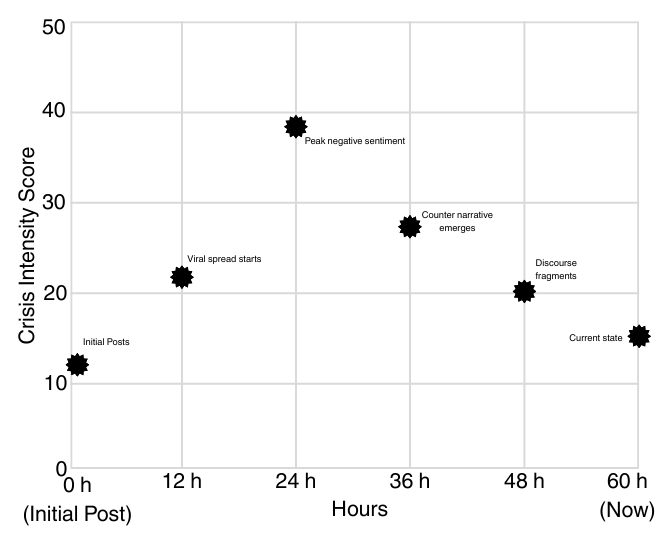
Usually, when commentary on a specific person takes over the feed like this, demonstrating a crisis escalation timeline typical of social media crises (see below), they’ve recently done something that set it off. And usually, I can find what that is in a couple of minutes.
Not this time.
I couldn’t find a triggering incident in which Brown herself did something specific in the past week.
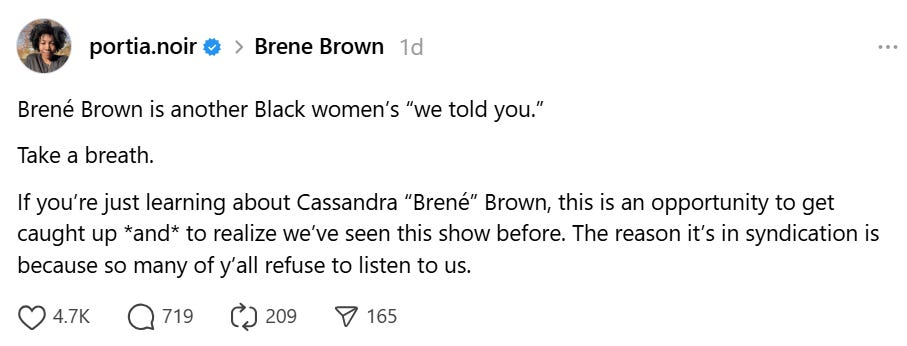
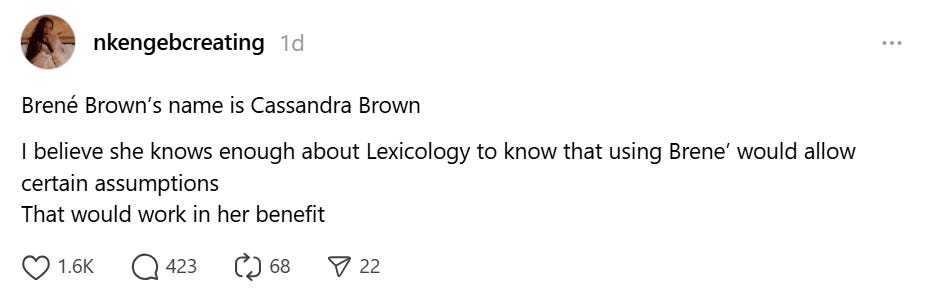
Instead, the discourse appears to have originated from these two posts below, which catalyzed a broader discussion on Brown, reflecting a long-standing sentiment among some Black scholars and activists that their work has been systemically overlooked and appropriated by more privileged figures.
What are people saying?
[NOTE: I have an interest in this situation from a professional perspective. I am looking at it as an analysis of viral online discourse from a crisis management perspective. This post offers some insight into what I do when I look into online discourse for my clients. It should not be interpreted as a definitive statement on the individuals or issues involved.]
The core accusations against Brown currently being discussed on Threads are as follows (these are summaries of what people are saying, not statements on the validity of any of the claims):
Intellectual Co-Option: The primary claim is that Brown has built her multimillion-dollar career by taking concepts, theories, and research from Black women scholars and theorists without adequate credit or attribution. Critics argue she repackages these ideas in a “race-neutral” and “class-neutral” way that is more palatable to a mainstream white audience.
Name Controversy: A secondary, though highly discussed, point of contention is the claim that Brown’s given name is Cassandra, and that she uses her middle name, Brené, to sound “more white” and benefit from racial ambiguity. This claim, even if unproven, has been cited on Threads as evidence of a deliberate attempt to distance herself from Blackness while profiting from Black intellectual labor, with numerous other posters commenting that Brown has used the name since childhood.
This discourse did not emerge from a single recent event.
Sentiment Analysis
We use sentiment analysis to analyze public discourse in crisis management to assess reputational risk. It helps us understand how people are reacting, determine whether their reactions are mostly negative or positive, gauge the emotional intensity of the situation, and get a clear picture of the underlying feelings driving the conversation. This knowledge of public sentiment helps us craft messaging that speaks to the critical audience. It helps us understand which groups are most affected and where communications should be focused.
Sentiment analysis also helps identify emerging issues early so we can intervene before escalation and decide when to escalate, apologize, and change strategy.
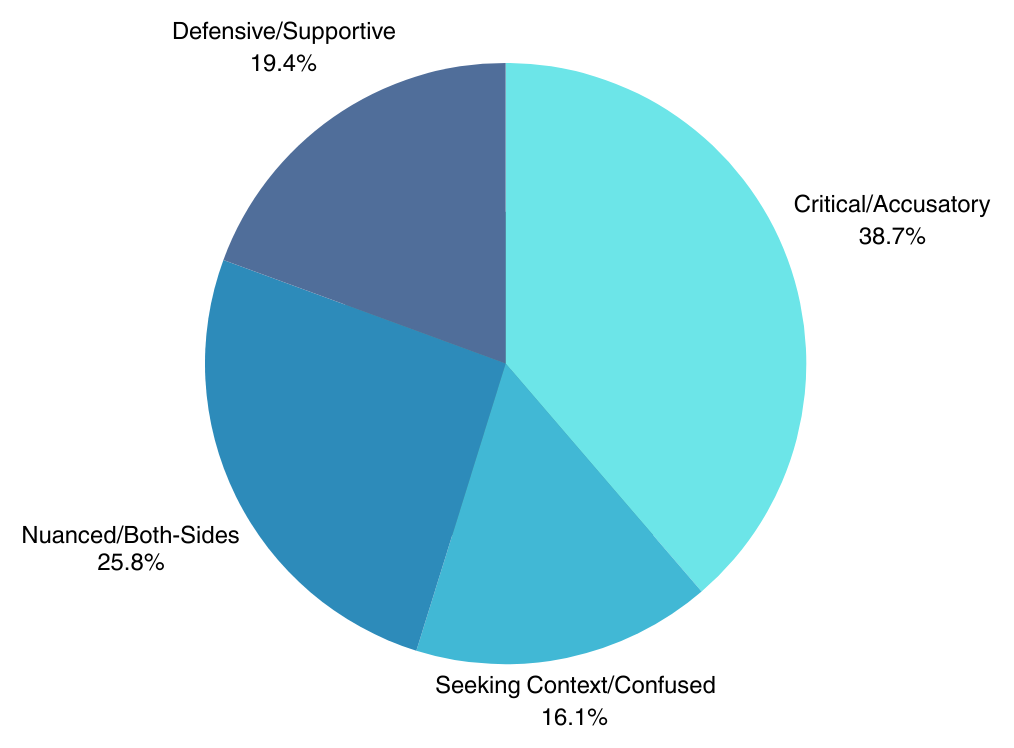
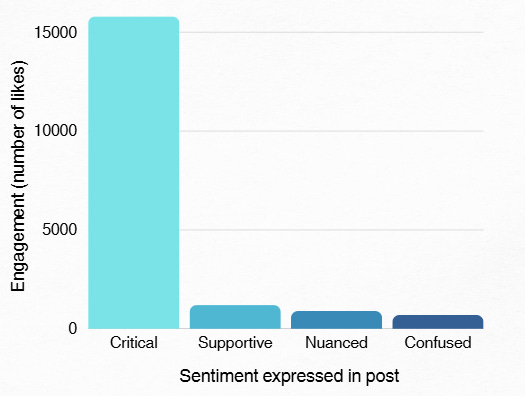
This conversation, like most in any oppositional crisis, is highly polarized. While the most engagement is on critical posts accusing Brown of intellectual co-optation, there are also significant defensive, nuanced, and confused segments of the discourse.
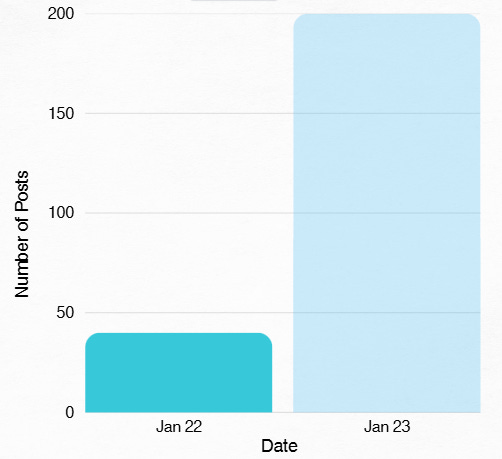
Looking at posts on Threads from January 22-24, 2026, the spike in posts about Brown is clear:
I categorized the sentiment distribution in these posts as follows:
Looking at the engagement (number of likes across posts in each category) revealed that the critical posts garnered the highest engagement (which is not unexpected):
I then looked at the key themes emerging in the posts:
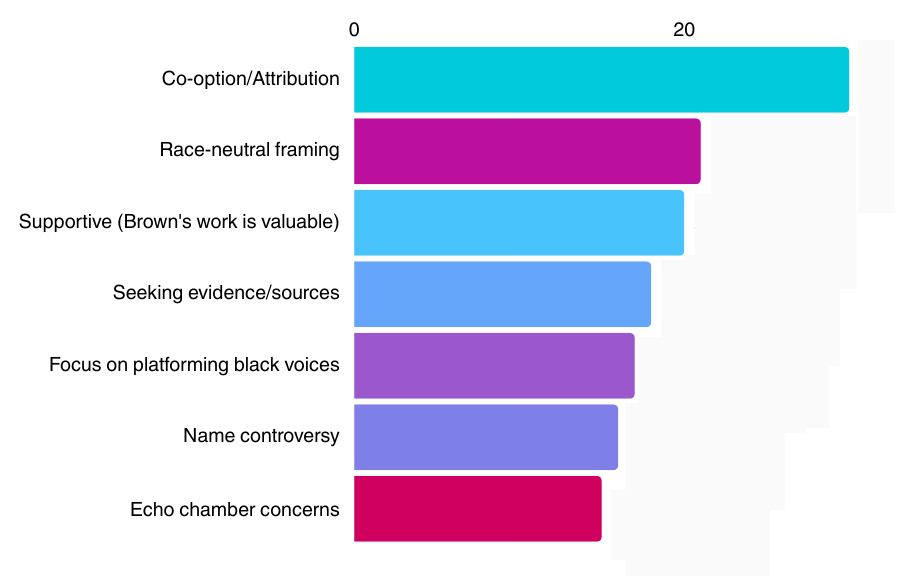
The most common themes by category are:
Critical: Co-optation of Black women's work, lack of attribution, race-neutral framing.
This is the most engaged-with category, driven by the initial viral posts. The sentiment is characterized by anger, frustration, and a sense of long-overdue reckoning. Users echoed the core claims of the posts I shared above, with one user (jessicaddickson) calling Brown “The Patron Saint of White Women.” The emotional core of this sentiment is the feeling that Black women’s intellectual labor is consistently erased and monetized by white figures.
Supportive: Her work is transformative, she credits sources, she has platformed Black voices.
Defenders of Brené Brown, such as user the.chocolate.therapist, argued that the critiques were “brain dead” and “misinformed.” They point to instances where Brown has credited other authors and platformed Black voices on her podcasts. This group often highlights the personal, transformative impact of Brown’s work on their lives and views the criticism as an unfair attack on a person of integrity.
Nuanced: "Two things can be true," critiques are valid but work is still valuable, need more evidence.
This significant portion of the conversation acknowledges the validity of the critiques while also recognizing the value of Brown’s work. Many users, like jalisa.reads.anywhere, shared that their Black therapists had recommended Brown’s books while also providing critical context. This group often calls for a more detailed, evidence-based discussion rather than outright cancellation.
Confused (Seeking Context): "What did she do?", need more context, first time hearing about this.
Many users are simply trying to understand the situation. Posts asking for context and specific examples of the alleged co-option are common, indicating that for many, this is the first time they have encountered such criticism of Brown.
There was also one piece of misinformation that stood out to me, where one user stated the following:
The tea on her is HOT tho because apparently she stole the entire “Let Them Theory” idea from someone else.
That is misinformation specifically because Brené Brown didn’t write the Let Them Theory. Mel Robbins did.
Strategic Insights from the Sentiment Analysis
[It’s important to note that this analysis is time-sensitive and reflects just one specific moment in the ongoing discourse.]
Analyzing sentiment data provides important insights for developing a crisis management strategy beyond the “positive vs. negative” perspective.
This reputational risk matrix is a map of the key issues and their potential to spread, along with the severity of the damage they could inflict on Brown’s brand, which is built on trust, vulnerability, and authenticity:
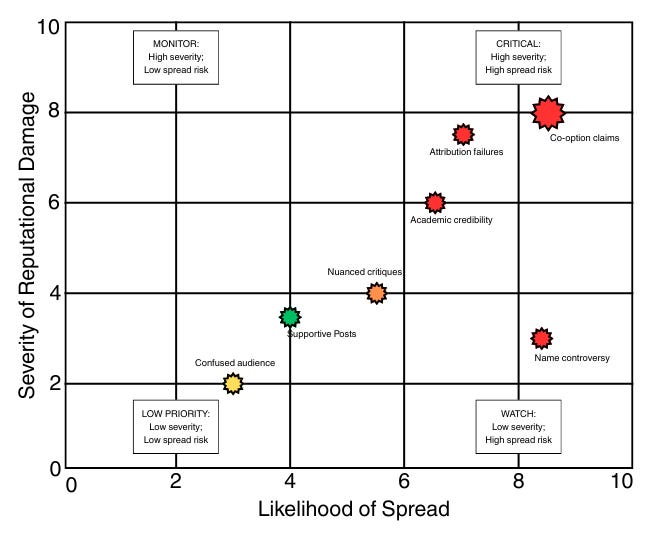
The most dangerous issues are the core accusations of co-opting Black women’s work and systemic attribution failures. These strike at the heart of Brown’s academic and personal integrity and have high virality potential because they are easily understood, emotionally resonant, and fit into a broader, pre-existing social narrative about racial and economic justice. These accusations represent a fundamental challenge to Brown’s credibility. The challenges to Brown’s academic credibility, such as one post that noted that she does not submit her work for peer review, are also significant, as her academic background is an aspect that establishes her trustworthiness among other, perhaps less ‘qualified’ speakers on similar topics.
The “Cassandra” name controversy may seem trivial; however, because it has been used as “evidence” for the broader co-optation narrative, it has a high likelihood of going viral, even if its direct reputational impact is lower. It could be used as a symbol of perceived inauthenticity.
Nuanced critics are a key battleground as they sit in the middle of the matrix. They are not outright hostile, but their concerns are valid and could be swayed toward the critical camp. Ignoring them would be a major strategic error, as winning their understanding and respect is key to containment and narrative control.
The sentiment analysis also reveals a conversation driven by high-intensity emotions, as the key issues are deeply personal and painful for many of the participants. The critical voice is fueled by outrage at the perceived injustice and a sense of betrayal, with a high emotional temperature. This indicates that, for this group, Brown’s work is perceived as harmful. The underlying feeling in this critical group is a sense of invalidation stemming from the perception that their intellectual heritage and labor have been erased. A purely logical or defensive response will fail because it does not address this emotional core.
The supportive group’s primary emotion is defensiveness and protection. They feel a personal connection to Brown and her work, and the attacks feel like an attack on their own experiences and values. They are also dismissive of the criticism, which can inadvertently escalate the conflict by invalidating the critics’ feelings. Invalidation is a key underlying feeling for this group as well, but in having their positive, transformative experiences with Brown’s work invalidated.
Not all voices in this conversation are equal in their influence or their stake in the outcome. A targeted communication strategy requires segmenting the audience and prioritizing engagement.
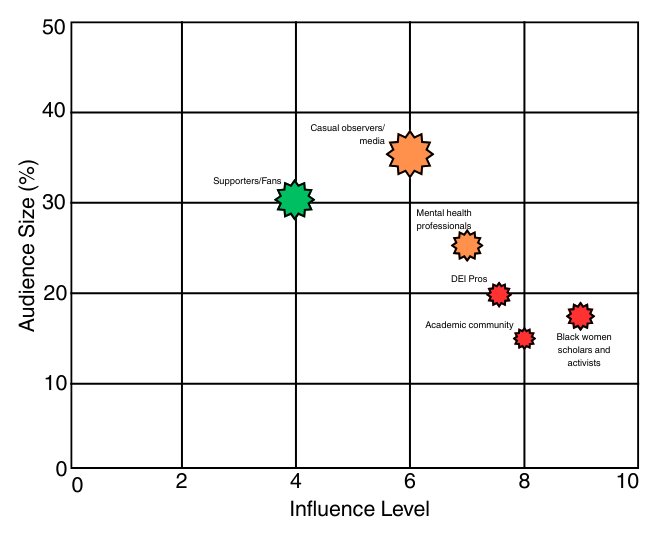
Though a smaller group in terms of sheer numbers, Black women scholars and activists have the highest influence and moral authority in this specific conversation. Their voices are the origin of the critique. Engaging with this group, even indirectly, is the most critical and most difficult task. The goal is not “change their mind”, but to demonstrate genuine listening and respect. This group is the top priority in any response.
DEI professionals and the academic community are also highly influential and are watching closely, concerned with issues of citation, ethics, and social justice. Their assessment could significantly impact Brown’s professional standing, and they’re likely looking for a response that is intellectually rigorous and ethically sound. This group is the second priority.
Mental health professionals, including therapists, express mixed sentiments. Many use her work in their practice, but are also trained to be critical and aware of social context. This group is strongly representative of the nuanced critics and is a key audience to engage with thoughtful, substantive content. This group is the third priority.
While the largest in size, casual observers/media, and supporters have less influence on the core debate. Messaging for these groups should be simpler and more direct. Supporters (fourth priority) need reassurance that their support remains valid, while casual observers and the media (fifth priority) need a clear, concise narrative that counters the negative one.
At the time I wrote this, the optimal intervention window (the first 12-18 hours) was already missed. A rapid, empathetic acknowledgment at this stage could have significantly reshaped the narrative and demonstrated responsiveness. However, ~60 hours later, the narrative has been allowed to continue and intensify, making any subsequent response more reactive than proactive. However, the intensity of the discourse has peaked, and the conversation is fragmenting into different subgroups. A more deliberate and thoughtful response aimed at long-term recovery and not immediate containment can help here.
The Response Strategy
Given the analysis, a passive or defensive strategy is untenable. The goal is not to win the argument but to transform a moment of crisis into an opportunity for growth, accountability, and a strengthened, more resilient brand. This requires a strategy rooted in Brown’s own teachings on vulnerability, courage, and accountability.
But I’m not really writing this for Brown. I’m writing it for you. Because this type of viral storm could happen to you, and the more prepared you are to handle it, the more likely it is that you won’t make the type of mistakes that make these situations worse.
If you find yourself at the center of social media discourse like this that is calling your own credibility, motivations, intentions, and authenticity into question, this may help you get through it and use it as an opportunity for growth and improvement.
Missed the 12-48 hour optimal window? There’s still time for thoughtful recovery… don’t knee-jerk now.
Silence vs. Engagement
Silence can be interpreted as guilt, arrogance, or a dismissal of the concerns. And it can allow the negative narrative to dominate and solidify… However, in some cases, it can also prevent fanning the flames of a short-lived controversy.
Engagement, via a well-crafted response, can demonstrate accountability, empathy, and a willingness to learn. However, a defensive or poorly worded response can significantly escalate the crisis.
The decision to remain silent or engage should be made according to:
The credibility of the criticism
The severity of the issue
The availability of accurate information
Your ability to respond thoughtfully without escalating the situation
If you’re going to engage:
The strategic goal of your response should acknowledge the validity of the discourse and demonstrate genuine accountability. For example, in this case, are there shortcomings in attribution or framing? Acknowledge them. Reaffirm commitment to the central aspect being called into question (ethical scholarship and the amplification of marginalized voices, in this situation) to help rebuild trust with key audience segments and protect long-term brand integrity.
Acknowledge/listen
Identify your guiding principles and ensure your response aligns with them. For Brown, an effective response would model vulnerability rather than defensiveness, as this is a key principle she espouses, along with showing listening rather than a knee-jerk response.
Acknowledge the uncomfortable truths, engage with the difficult feedback, and look at what you can do moving forward.
Within the initial 24 to 48 hours, focus on acknowledgment and listening. You could issue a brief, human-centered statement on the platform(s) where the discourse is occurring. In this case, that could involve thanking the people leading the conversation (particularly Black women scholars) and explicitly affirming a commitment to listening, reflection, and learning. The tone of initial messaging like this should be restrained and sincere, avoiding defensive apologies, excuses, public debates, or promises of immediate resolution.
The purpose of this phase is not to resolve the issue, but to signal respect for the discourse and a willingness to engage thoughtfully.
Action/engage
Next, focus on action and substantive engagement. You might write a comprehensive response published on a personal platform, allowing space for nuance, directly naming and addressing the core criticisms. In this case, for example, concerns around co-optation, attribution, and the limitations of race-neutral frameworks. This response should take specific responsibility where appropriate, acknowledge unintended impact regardless of intent, and transparently address sensitive issues that have contributed to mistrust. You should also include, where possible, concrete, nonnegotiable actions that demonstrate accountability beyond your words. (Communication cannot fix everything… actions must match communication for reputation rehabilitation). In this case, targeted private outreach to professional and institutional stakeholders could help rebuild trust and invite dialogue outside the public spotlight.
Integrate/change
The final phase involves long-term integration and sustained change. All commitments you have made in earlier phases must be followed through transparently and consistently. The lessons from the critique should be visibly reflected in your future actions. In this case, for example, that could be through stronger attribution practices and an ongoing commitment to amplifying marginalized voices. The goal is to demonstrate that the response is a permanent change in approach, not a reactionary measure to “make the issue go away”.
The sentiment analysis here suggests this could be a serious and credible reputational crisis, rooted in emotionally and intellectually grounded critique from influential audiences. If you face similar, issuing a dismissive or defensive response risks lasting damage to credibility. However, responding with humility, accountability, and meaningful action provides an opportunity to both mitigate harm and strengthen the integrity and long-term impact of your work.
The path forward in situations like this is almost always leadership through the discomfort of the critique.
Participating in online discourse?
It’s worth considering how you interact with viral topics when they come up on your for-you page to determine whether you really want to contribute to the discourse. Before reacting, take a moment to understand the context. Are people reacting without full information? Look for primary sources and a range of perspectives.
If you agree with the criticism, consider amplifying the voices of the people most affected. For example, in a situation like this, instead of stating your opinion, share the posts, articles, and books by Black women scholars at the center of the conversation.
If you’re not sure, it’s time to consider getting comfortable with the idea that two things can be true simultaneously… It is possible to have benefited from someone’s work while also acknowledging its valid criticisms. You don’t have to fall into binary, “for-or-against” thinking.
Not all online debates are productive. If a conversation devolves into personal attacks or bad-faith arguments… disengage.
In this particular case, your energy may be better spent reading the work of the scholars being discussed.